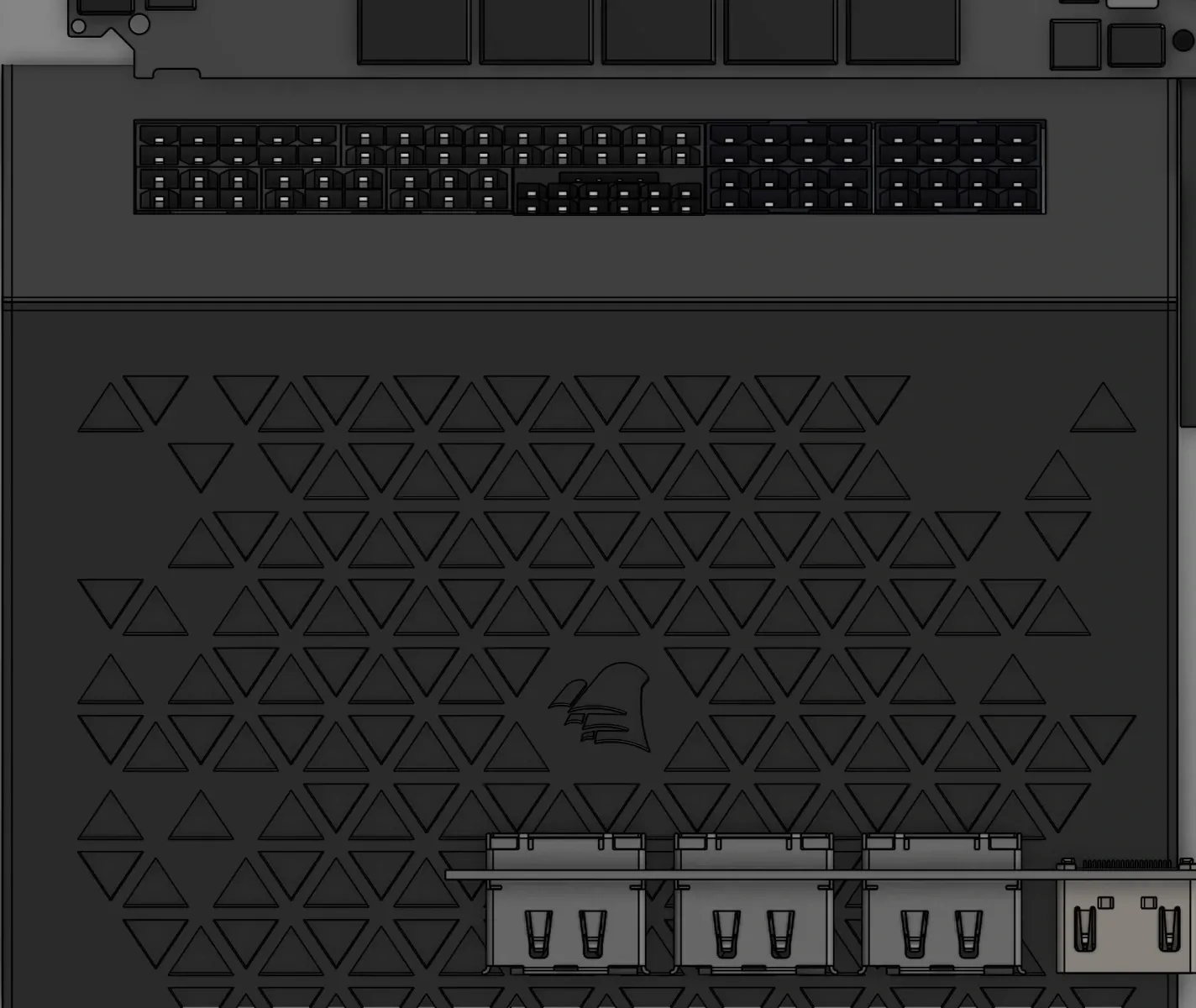
Folding PC Case

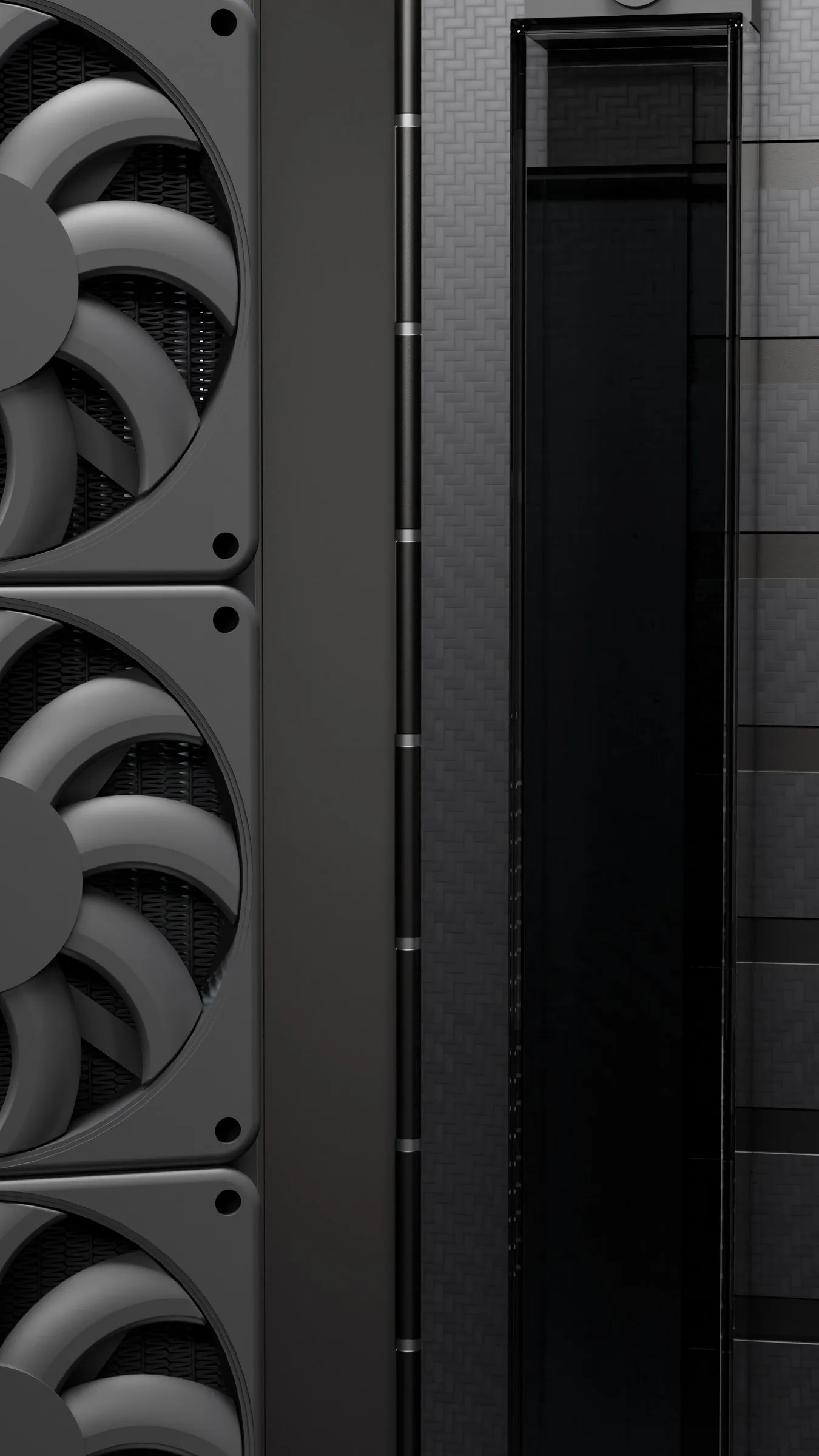
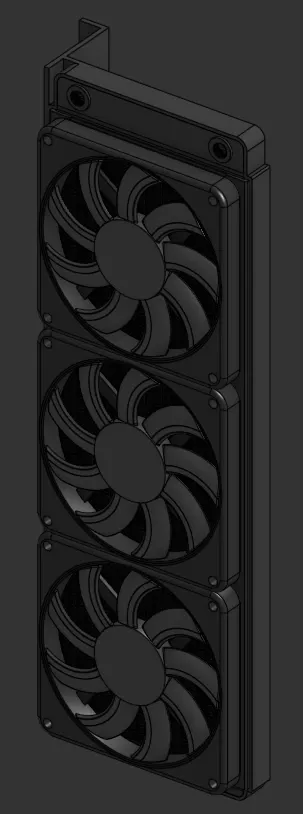
A water-cooled Mini-ITX case that folds in three, designed to fit dual 360 mm radiators in ~9 L.

Case volume
~9 L
Radiators
2 × 360 mm
Cooling capacity
~1,100 W est.

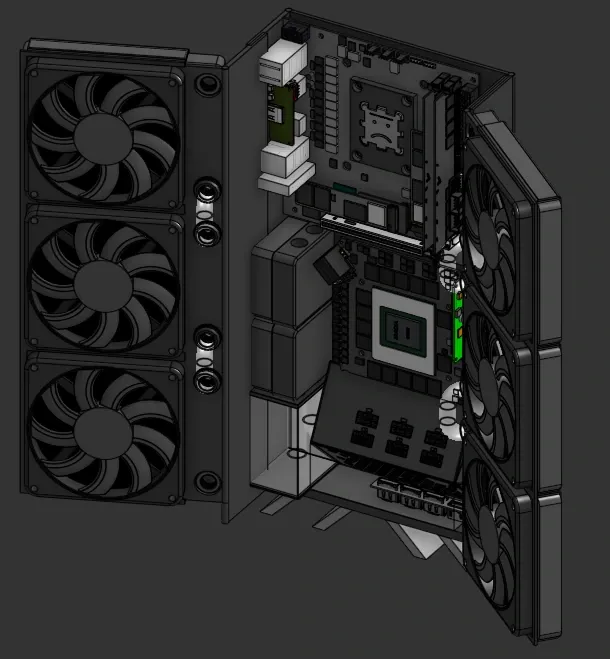
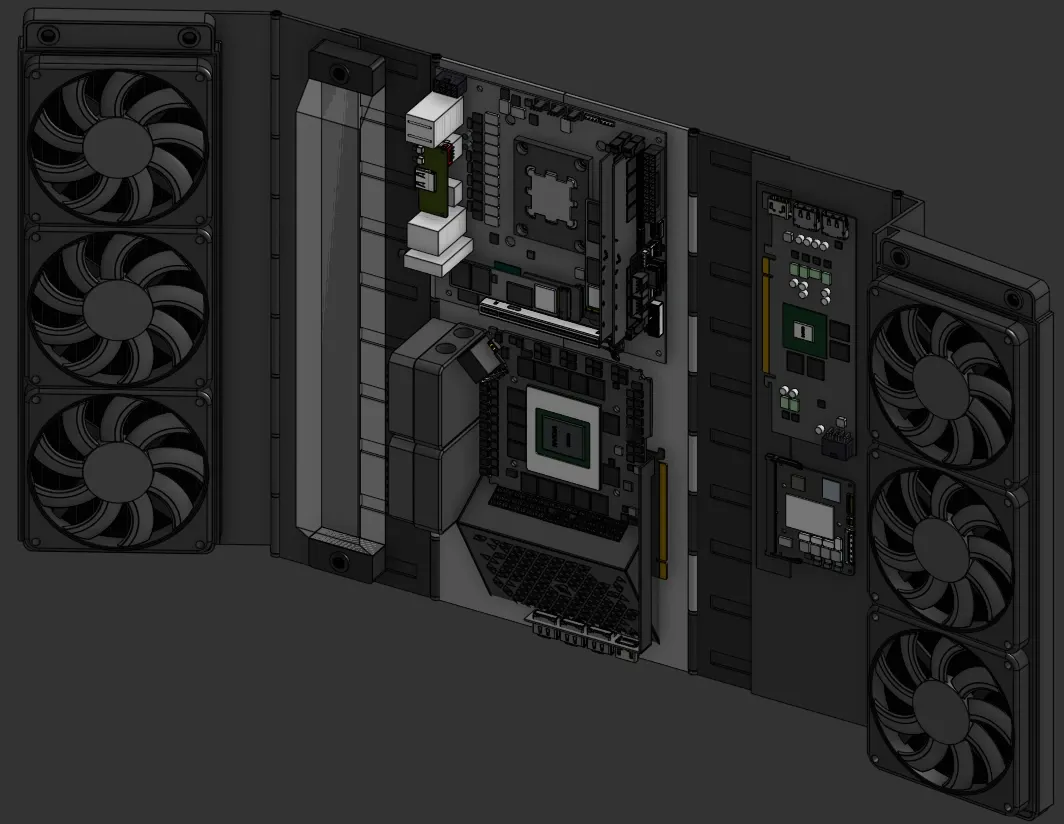
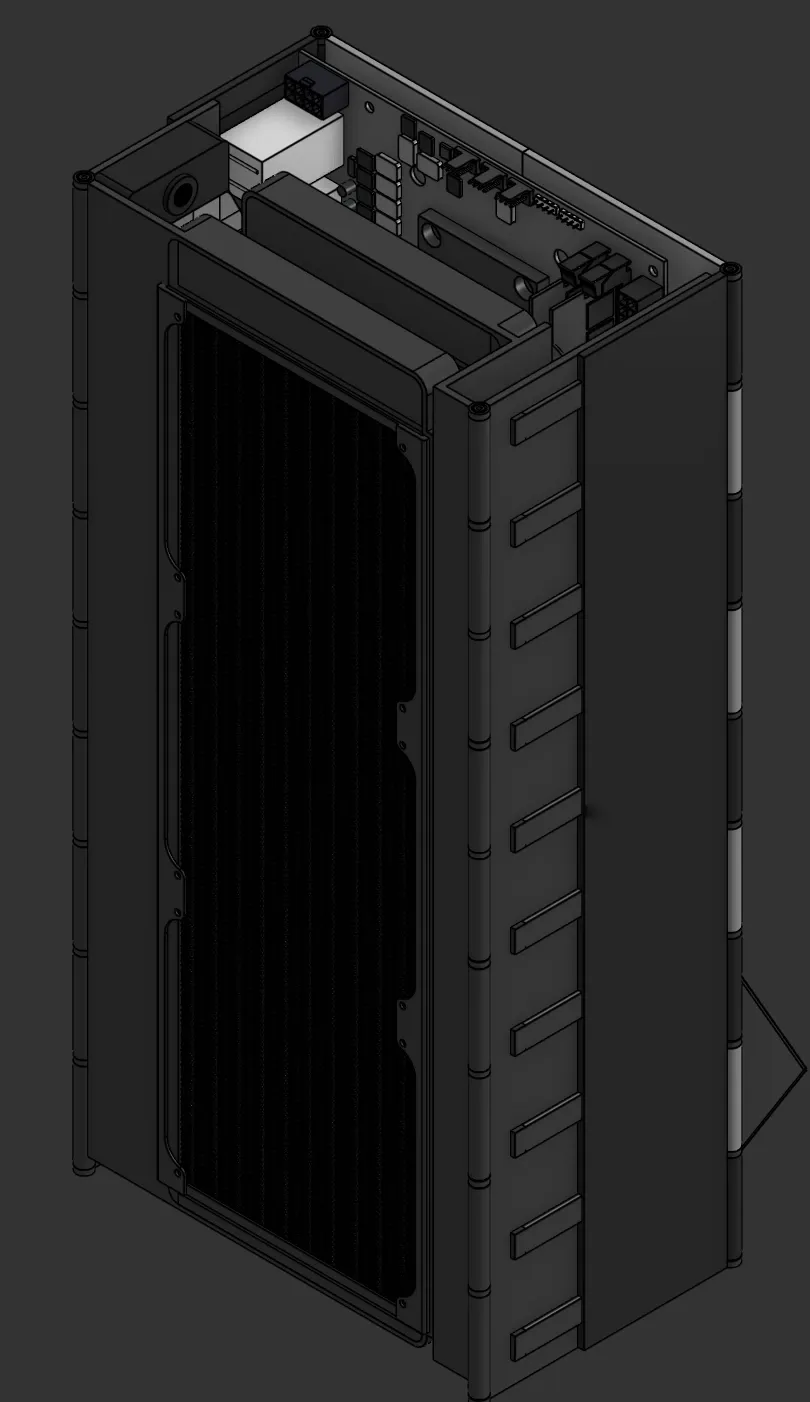
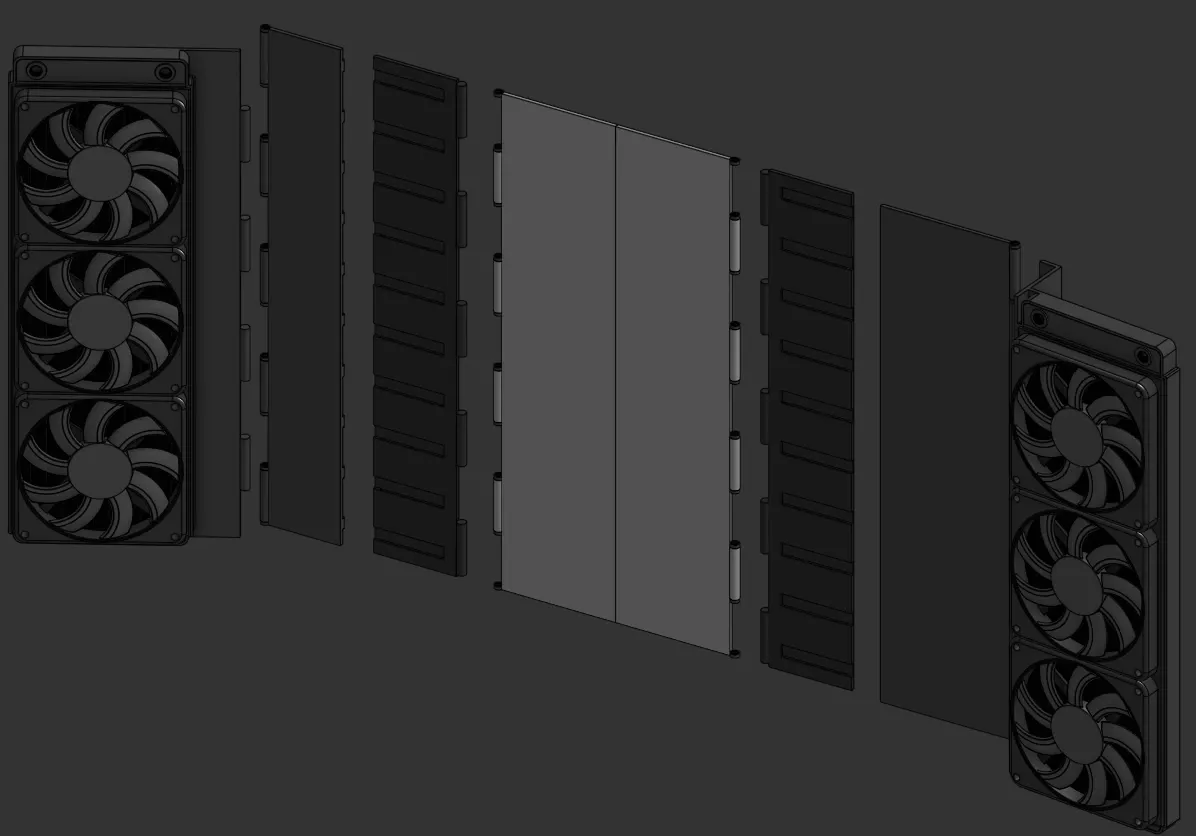
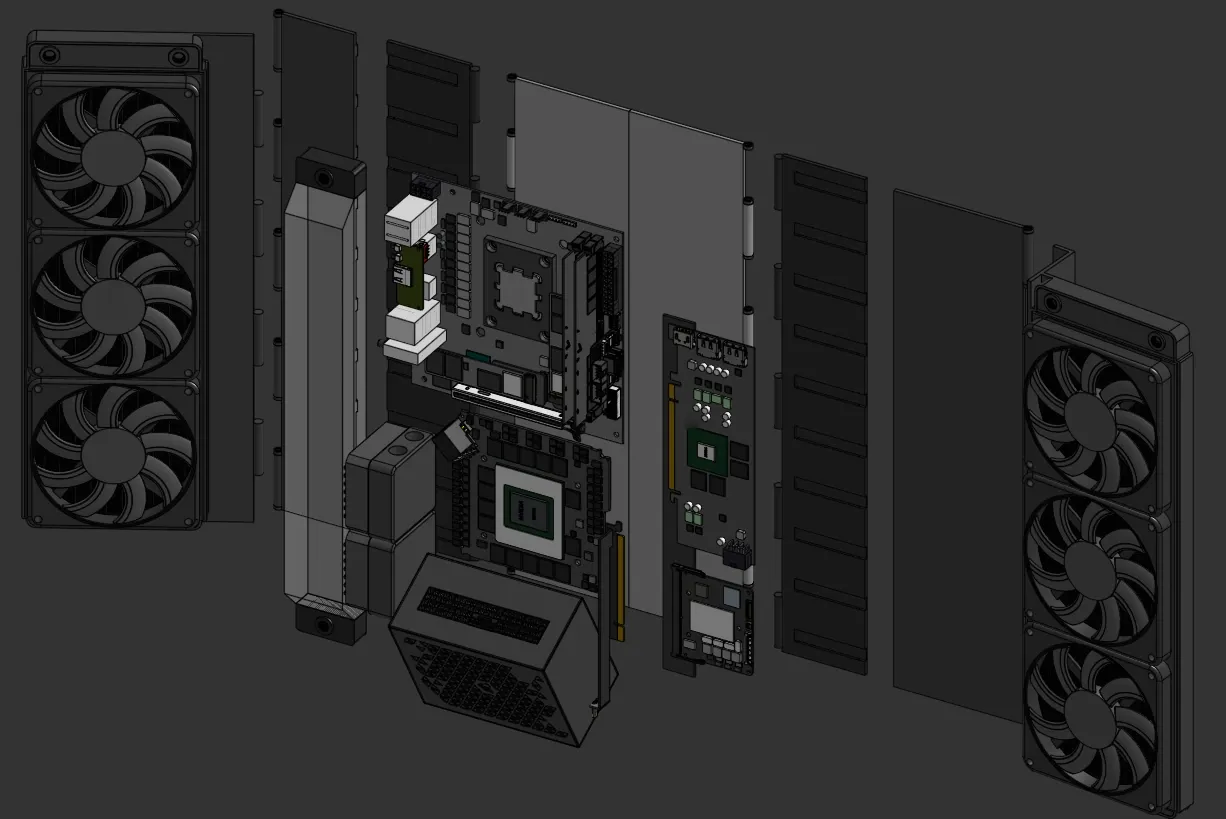
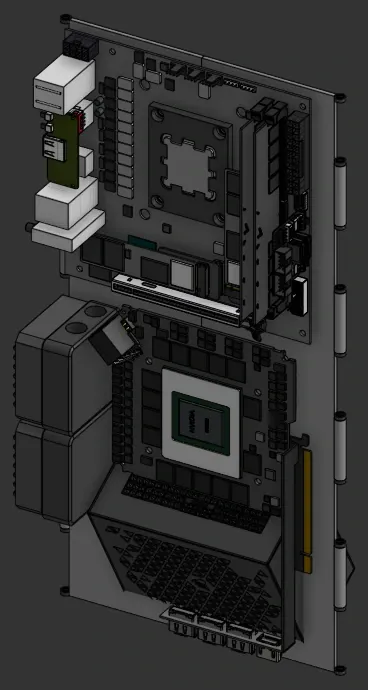
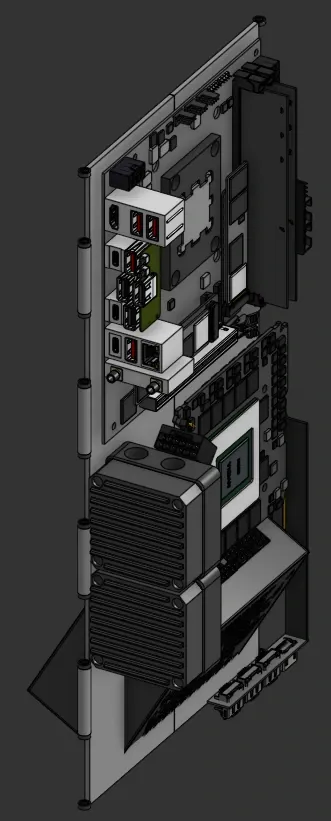
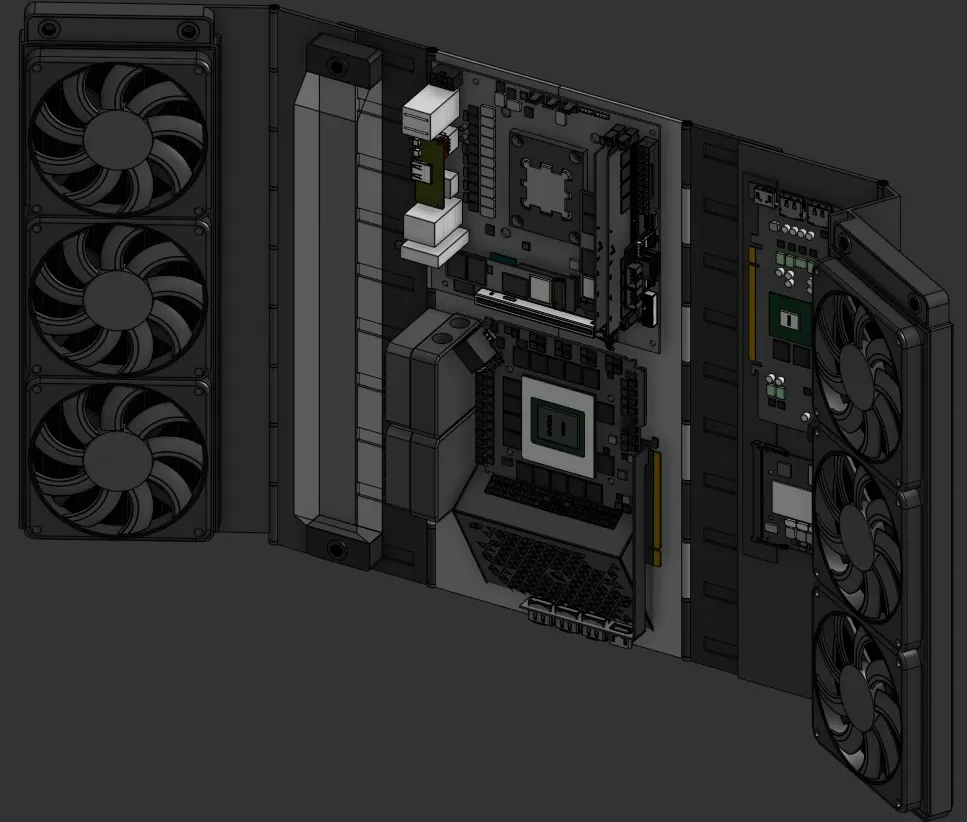
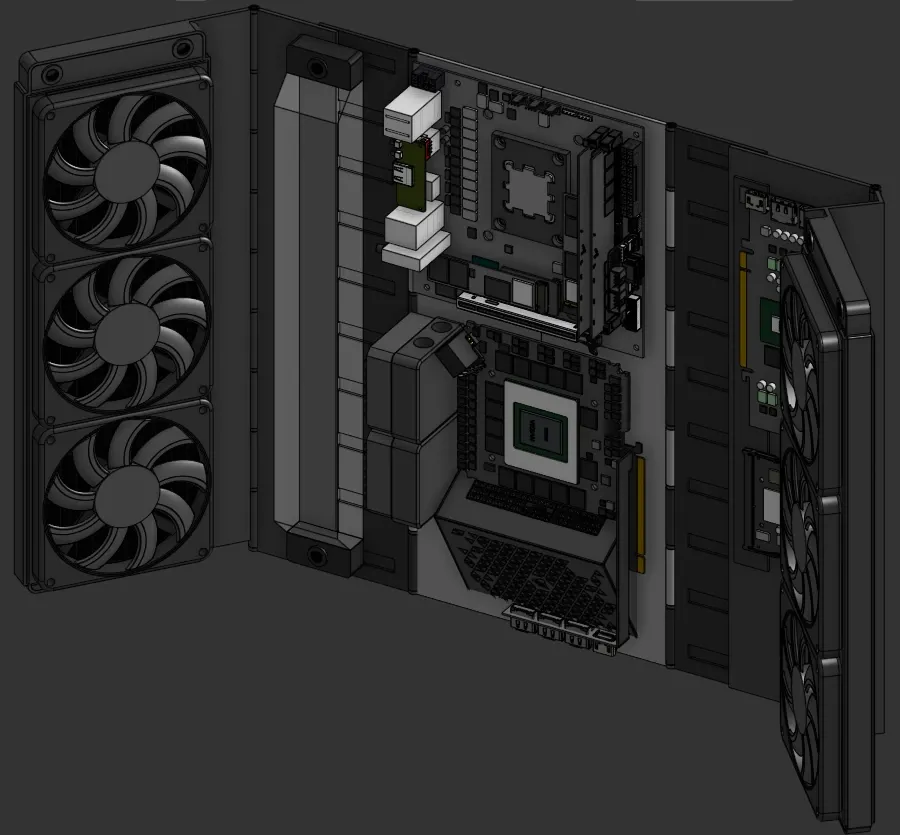
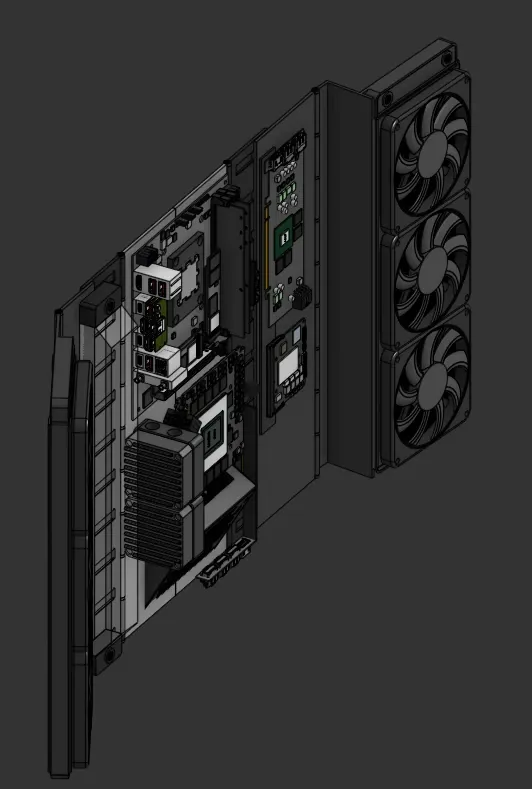
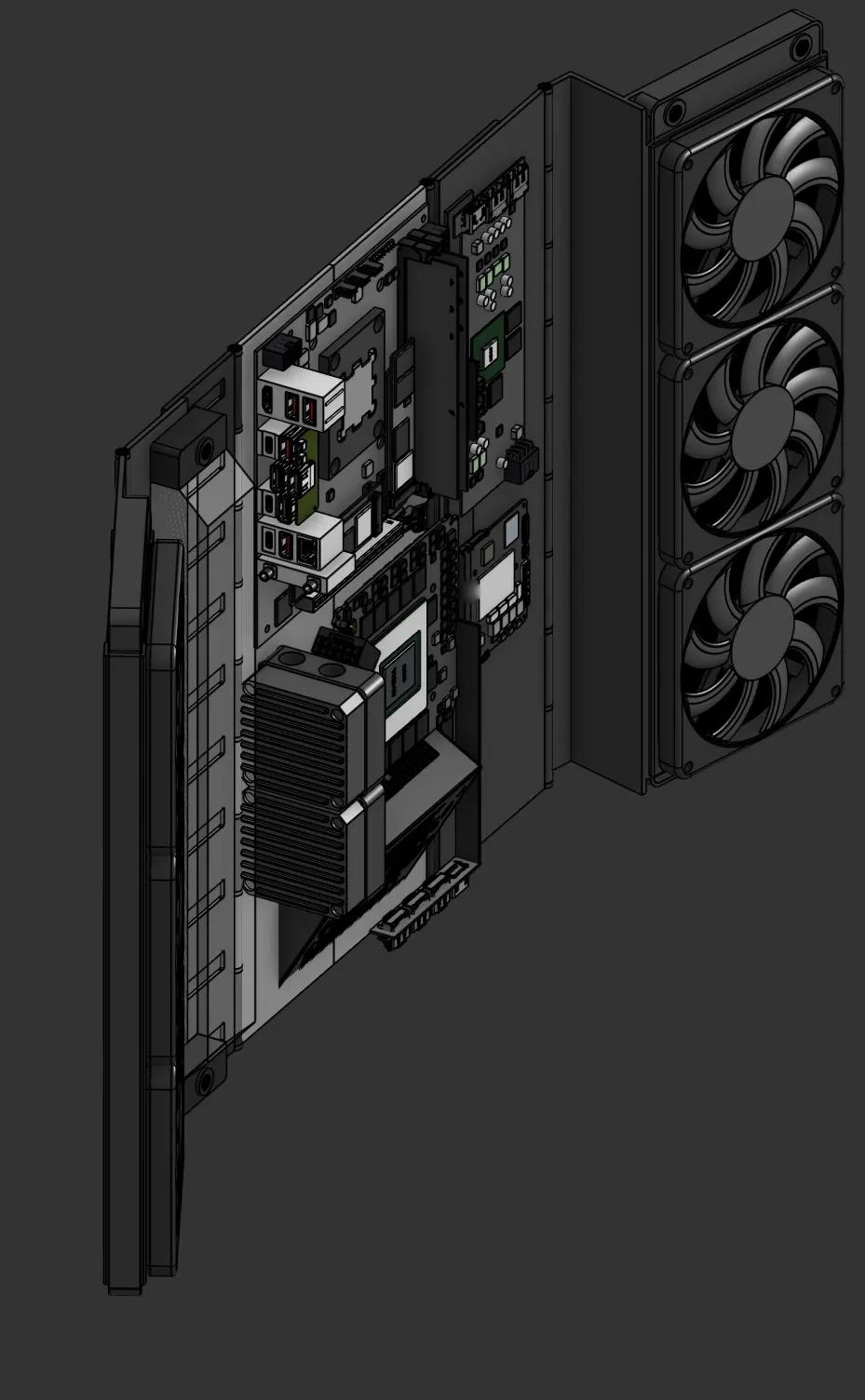
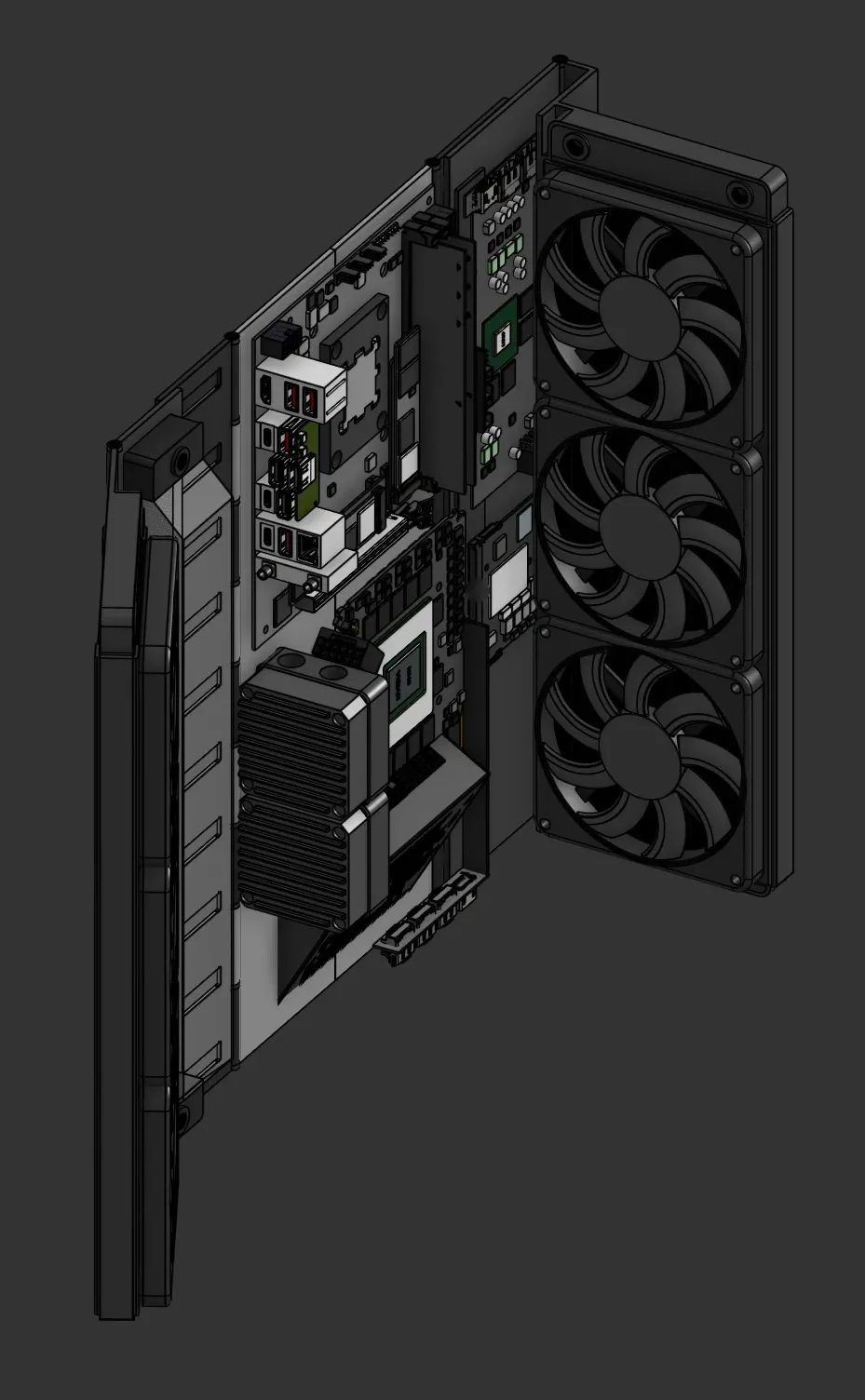
Folding PC CaseThe case open, isometric

1 / 10
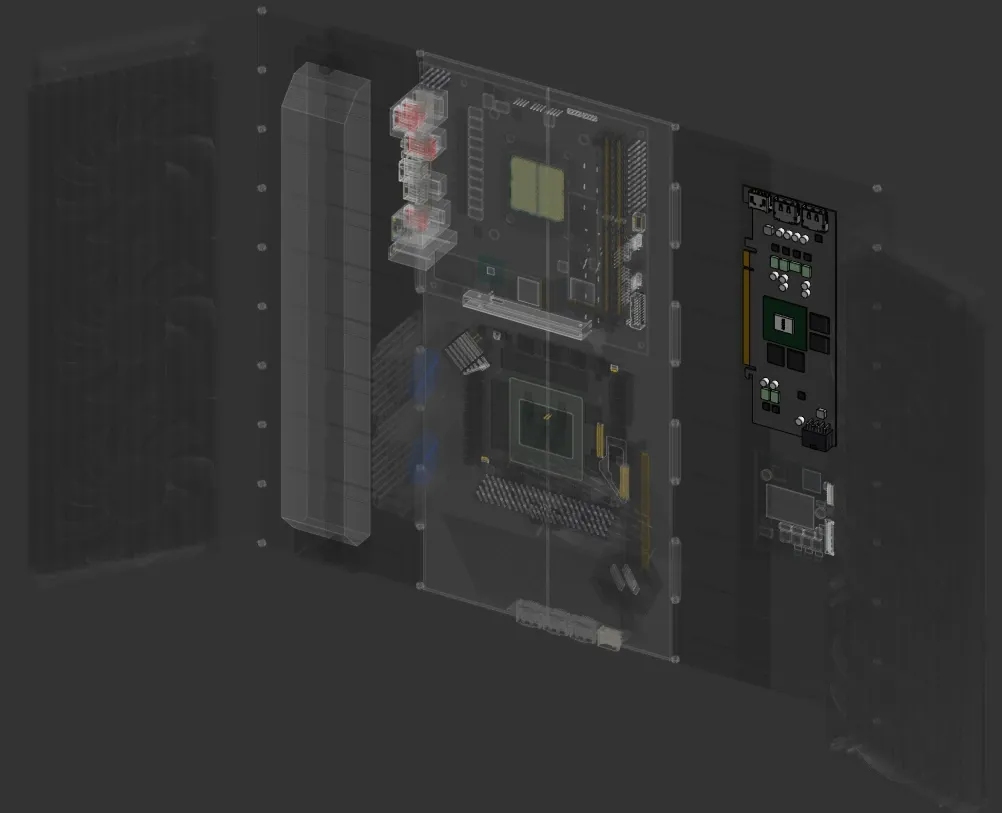
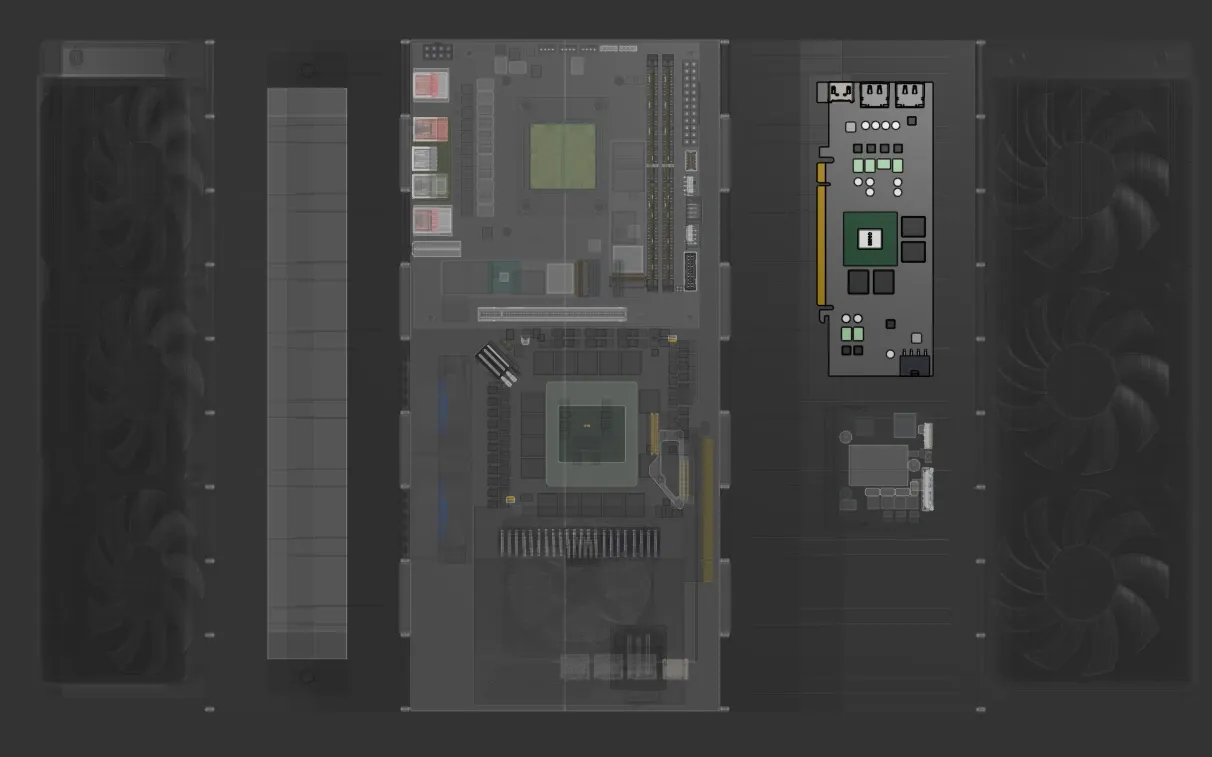
OpenClosedExploded

01Built to travel

Inspiration

A full-power, water-cooled PC that folds shut for the flight, then opens up so it never has to compromise on cooling.

  1. The problem

    Traveling often, and flying especially, with a high-performance PC means shipping it or trusting baggage handling. A small case fixes that, but water-cooling a small case always means a compromise.

  2. The usual compromise

    Small builds stack their radiators, so one breathes the other’s exhaust, or use one thick radiator, which can’t match two thin ones on fresh air at quiet fan speeds. Something always gives: thermals, performance or noise.

  3. The fold

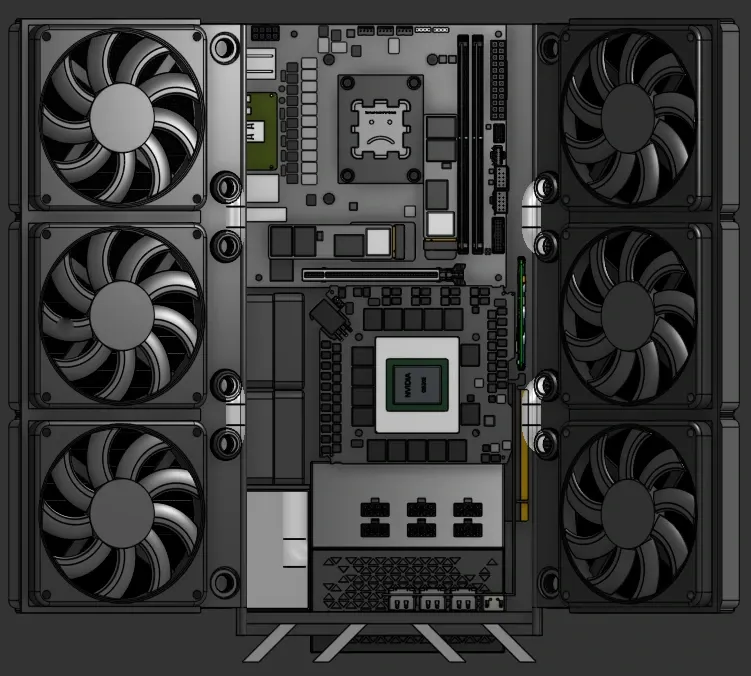
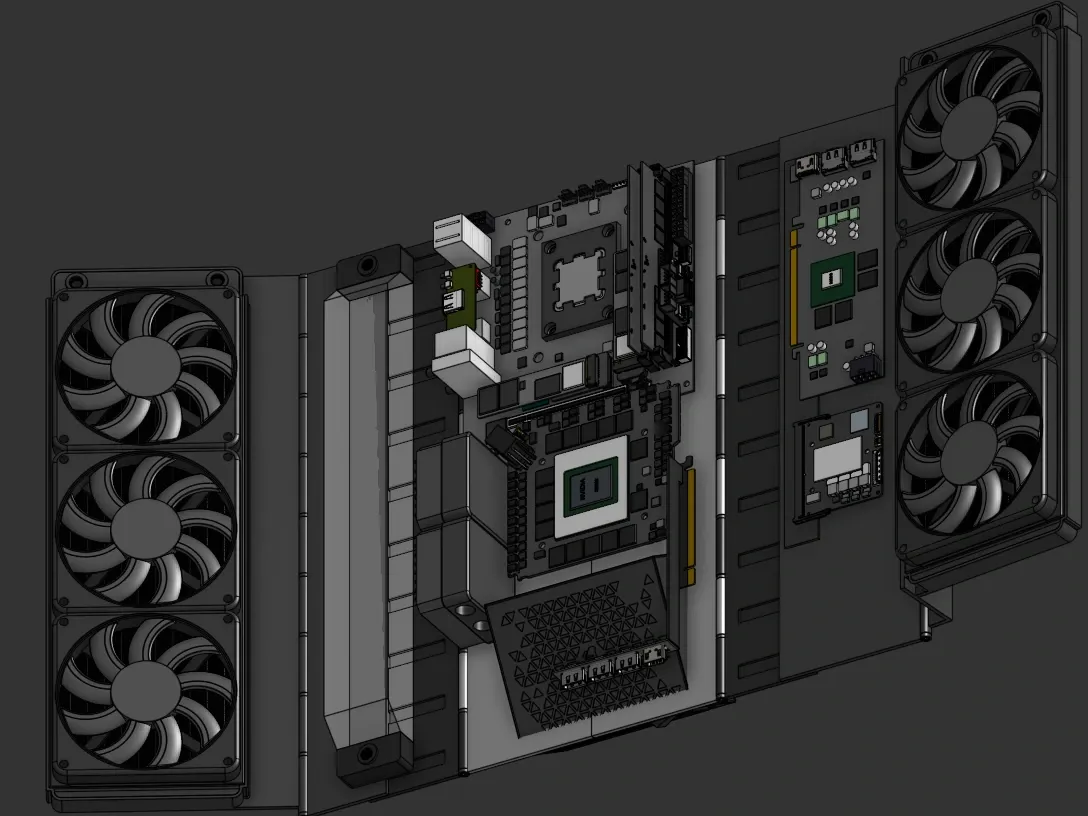
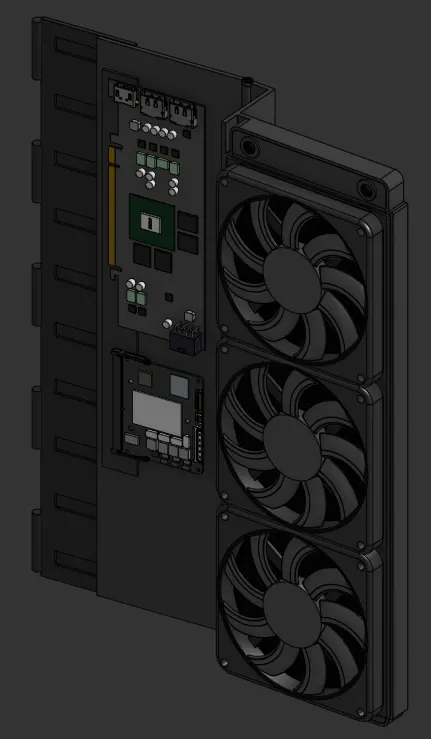
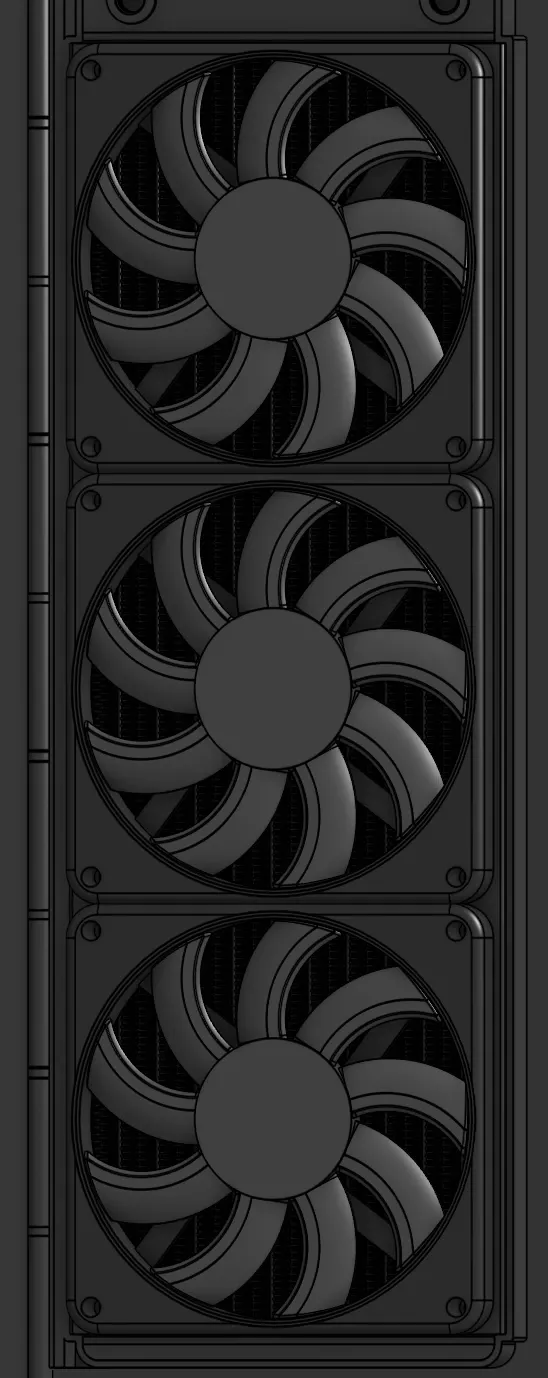
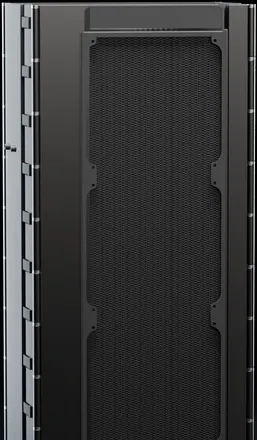
    For travel, the wings fold in and lock. Set up, they swing out so each radiator pulls its own fresh air: nothing stacked, no recycled heat, and a quieter build.
02Size

Cooling per liter

~9 L for an estimated ~1,100 W of cooling: ~122 W per liter.

CaseVolumeCooling, est.Cooling per liter, est.
Folding PC Case~9 L~1,100 W122 W/L
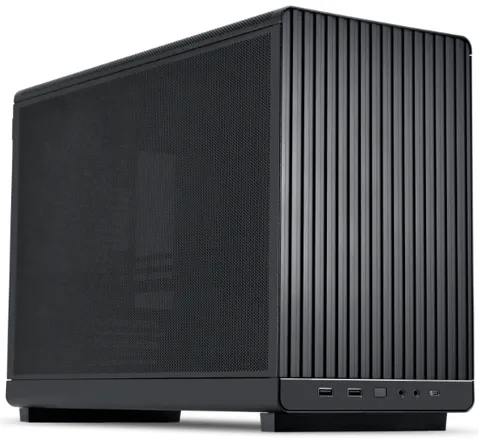
Lian Li A3-mATX26.3 L~1,100 W42 W/L
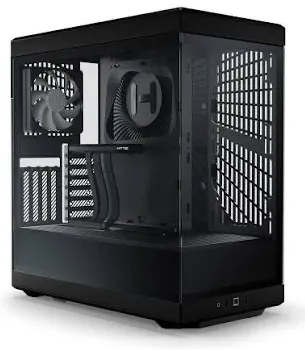
HYTE Y4050 L~1,050 W21 W/L
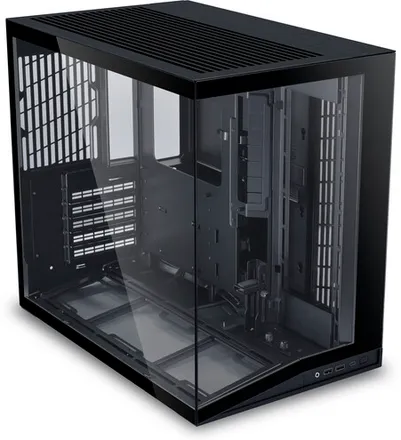
Lian Li O11 Dynamic Mini V245.4 L~900 W20 W/L
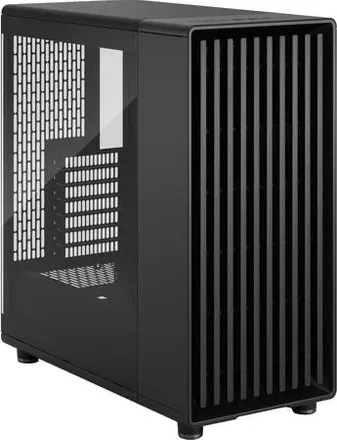
Fractal Design North42 L~800 W19 W/L
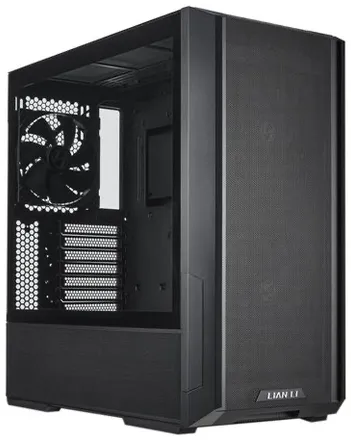
Lian Li Lancool 216~55.6 L~800 W14 W/L
Lian Li A3-mATX
Lian Li A3-mATX

42 W/L

Water-cooled, ~1,100 W in 26.3 L. That’s 2.9× less cooling per liter than this case.

Sources and method

Cooling per liter is the estimated cooling divided by the volume. Volumes are from each maker (the Lancool 216’s is worked out from its 480.9 × 235 × 491.7 mm size). Cooling is an estimate: water-cooled cases scale this case’s estimate by radiator area (a 140 mm fan slot counts as 1.36 × a 120 mm one); air-cooled cases add the RTX 5090’s own 575 W cooler to a large CPU tower cooler. Sources: Lian Li A3-mATX, Lian Li O11 Dynamic Mini V2, HYTE Y40, Fractal Design North, Lian Li Lancool 216.

03Mechanism

How it folds

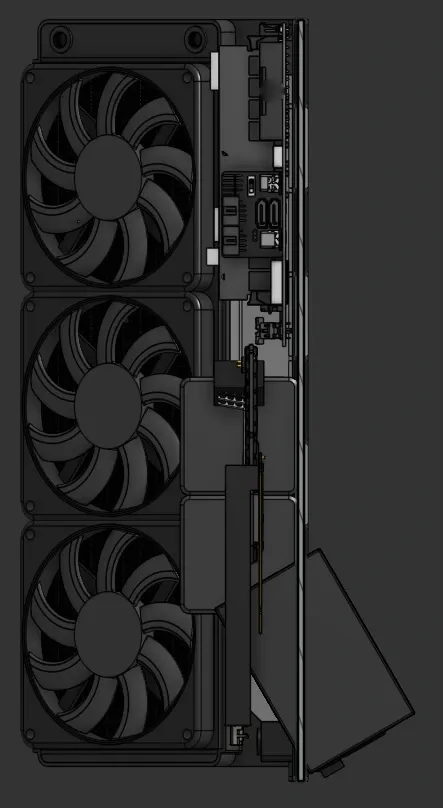
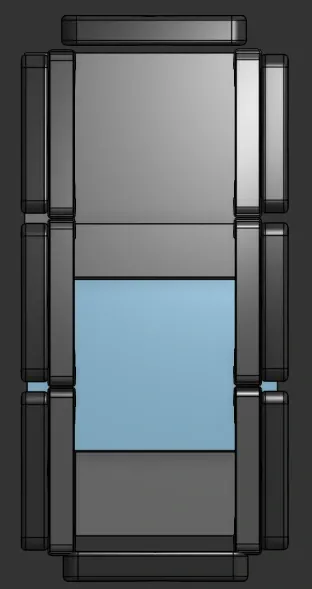
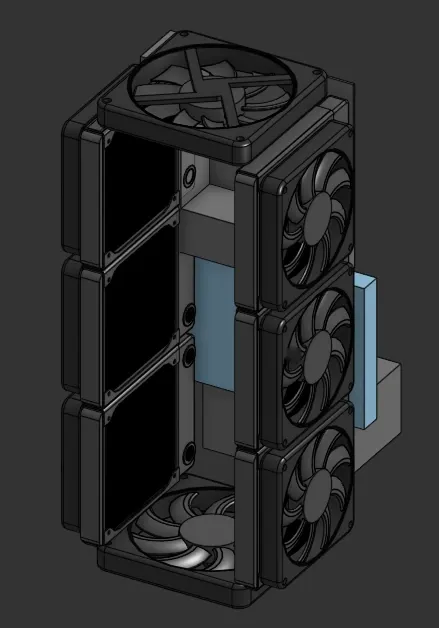
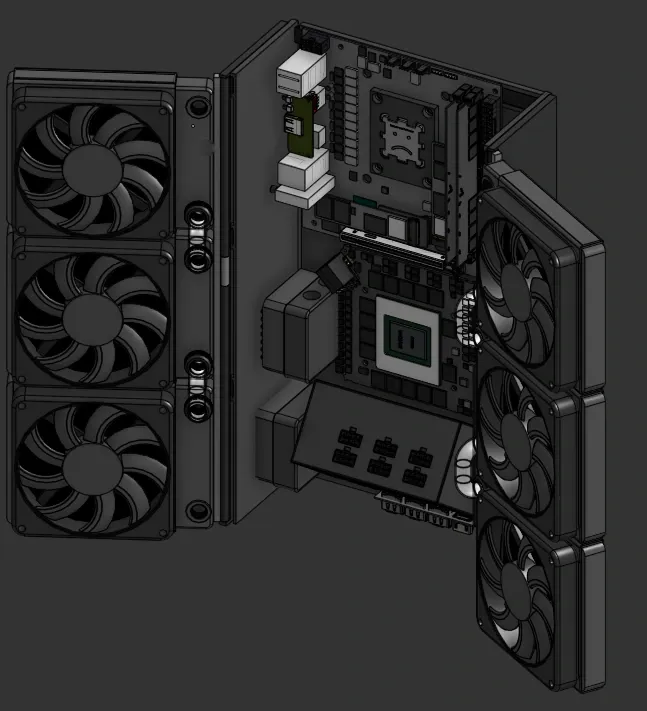
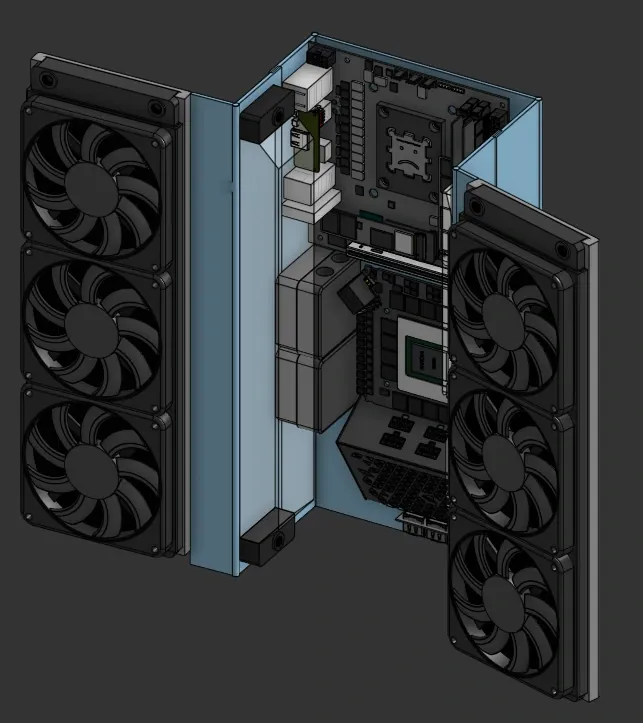
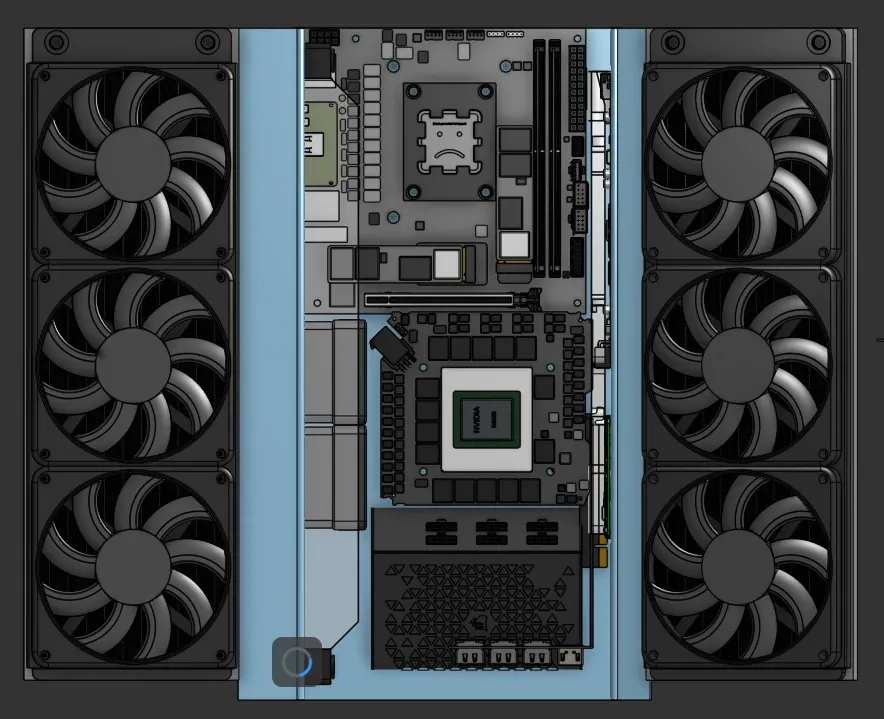
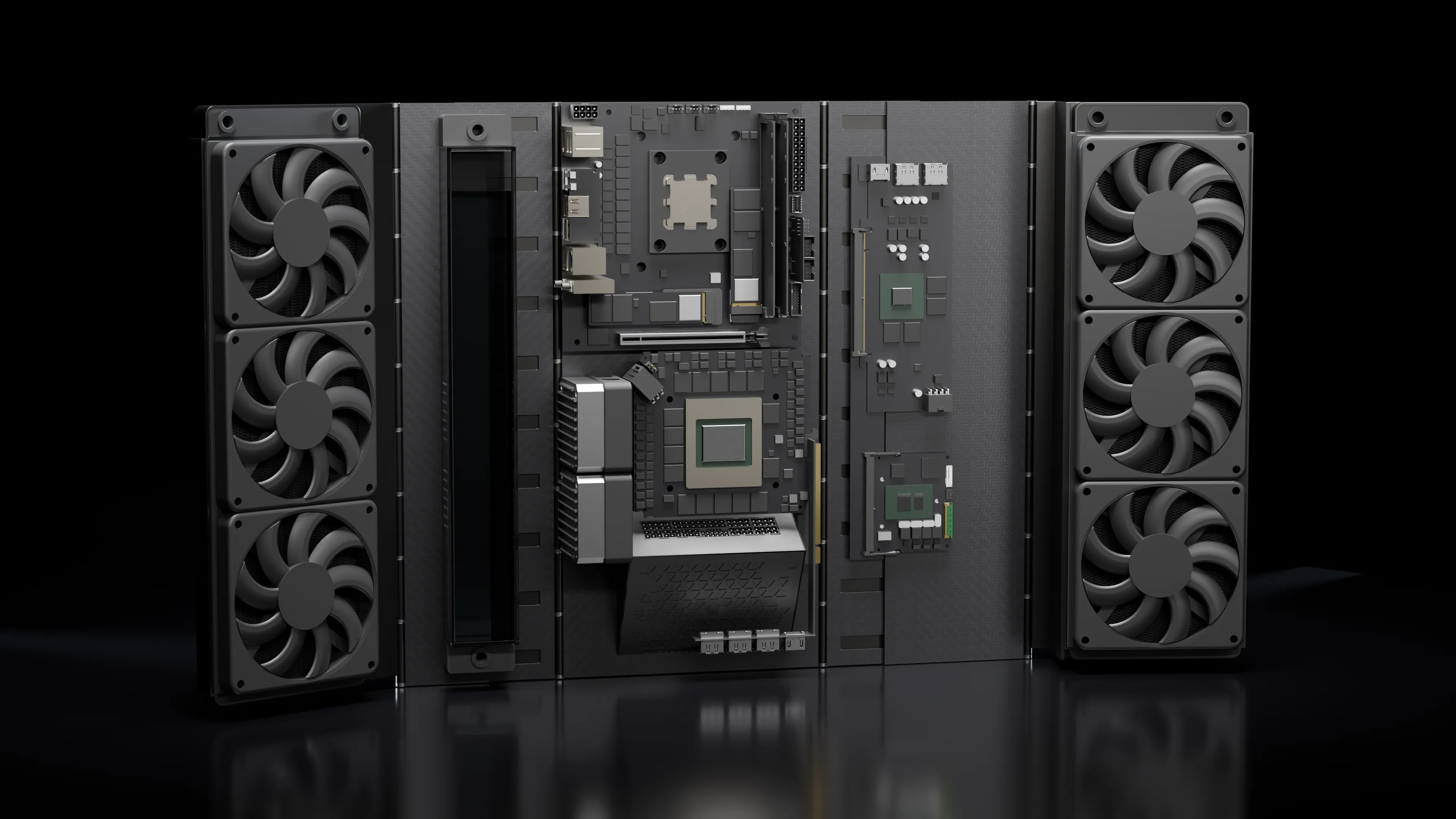
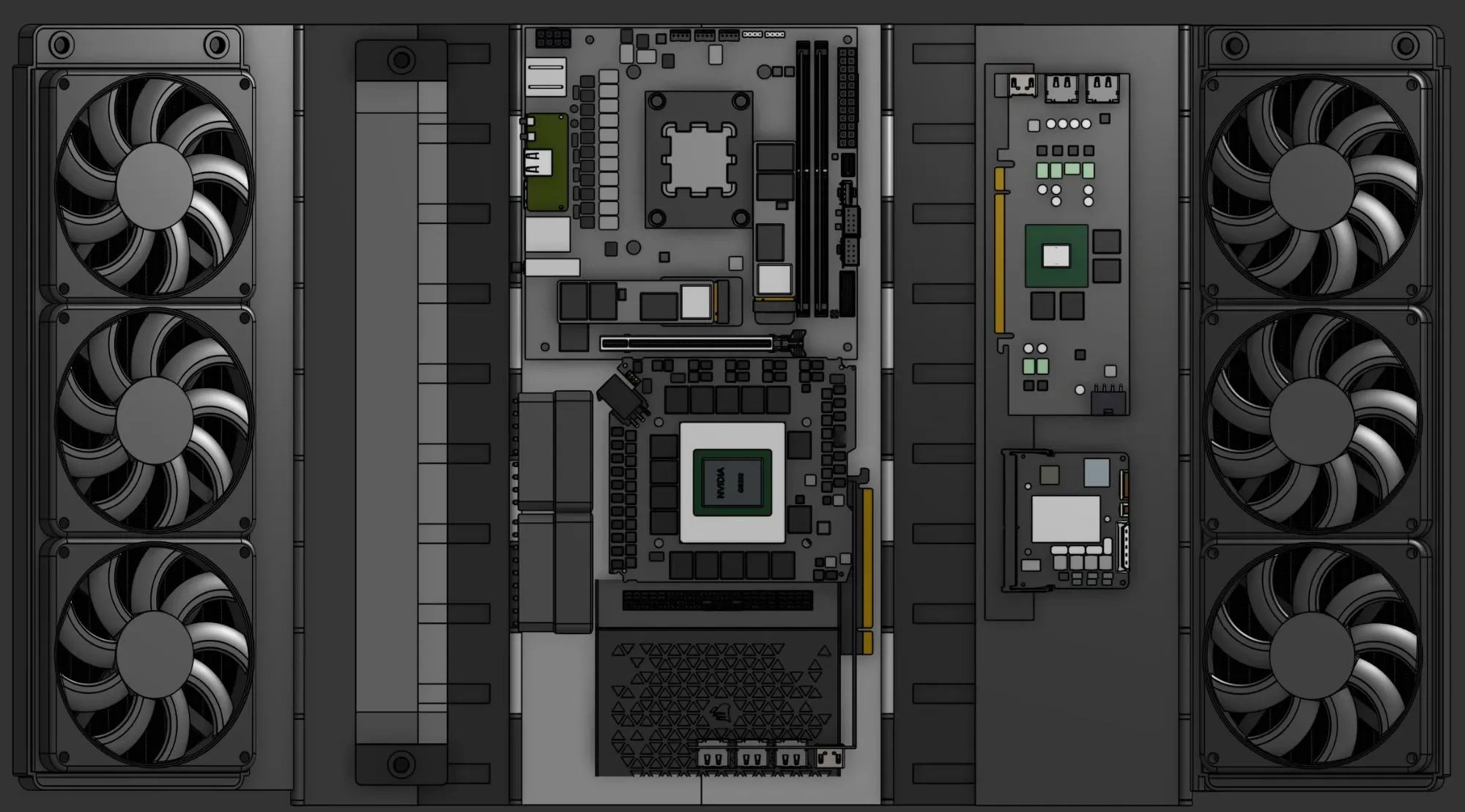
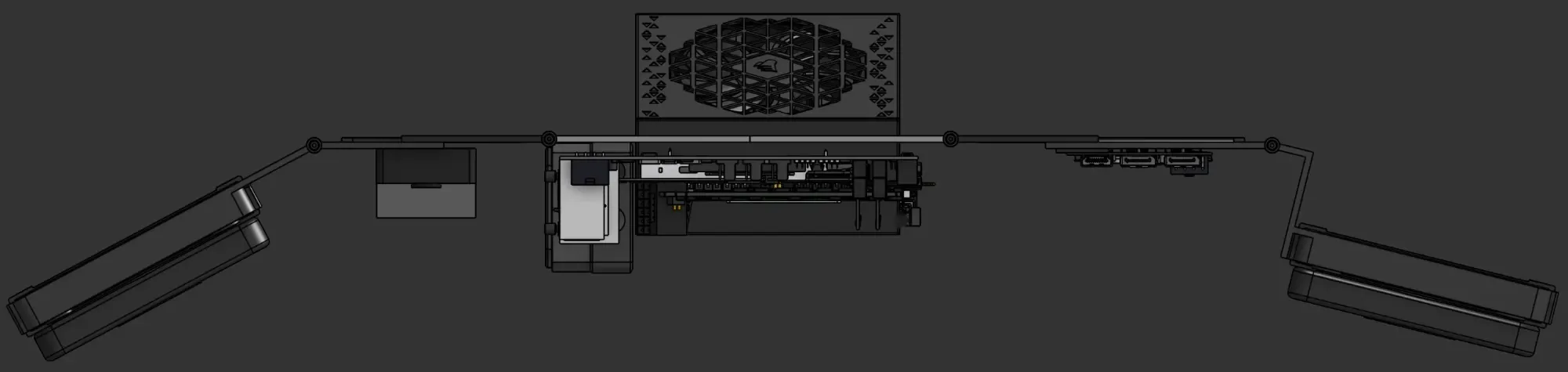
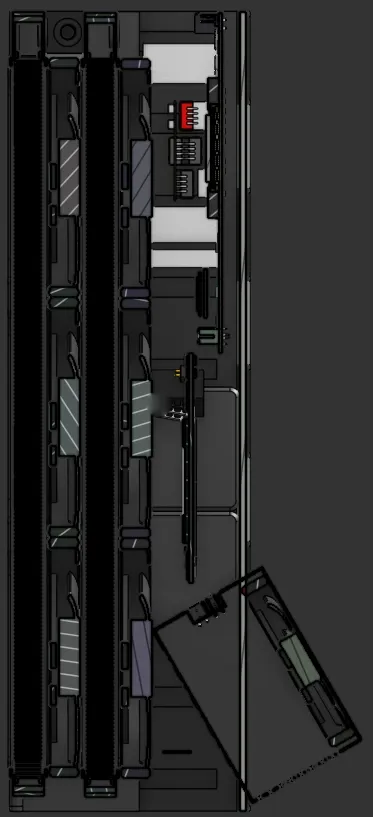
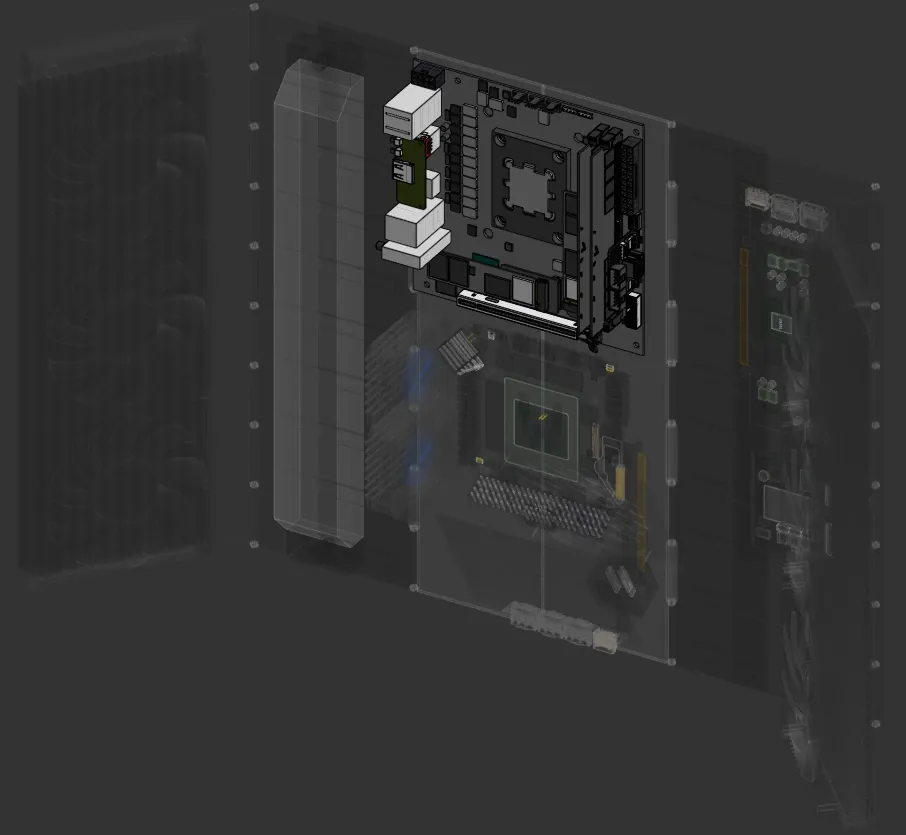
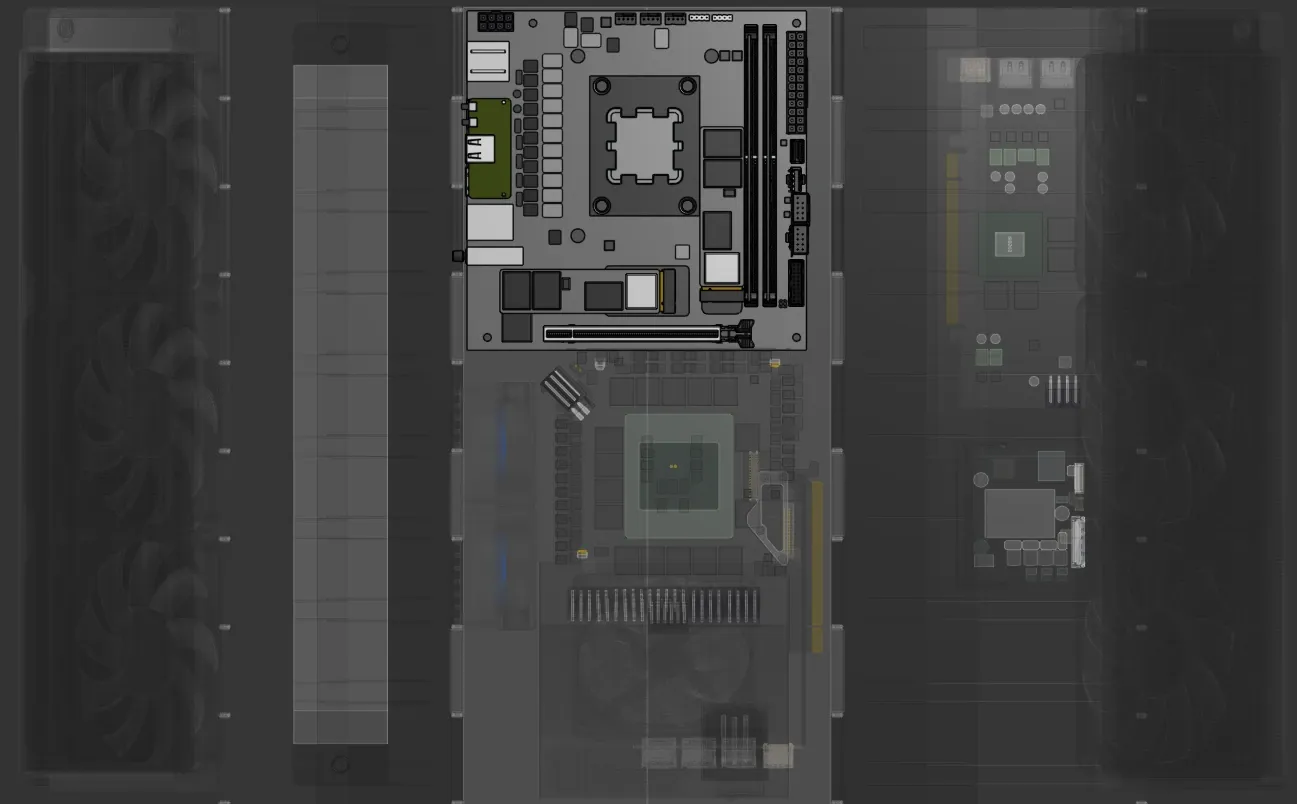
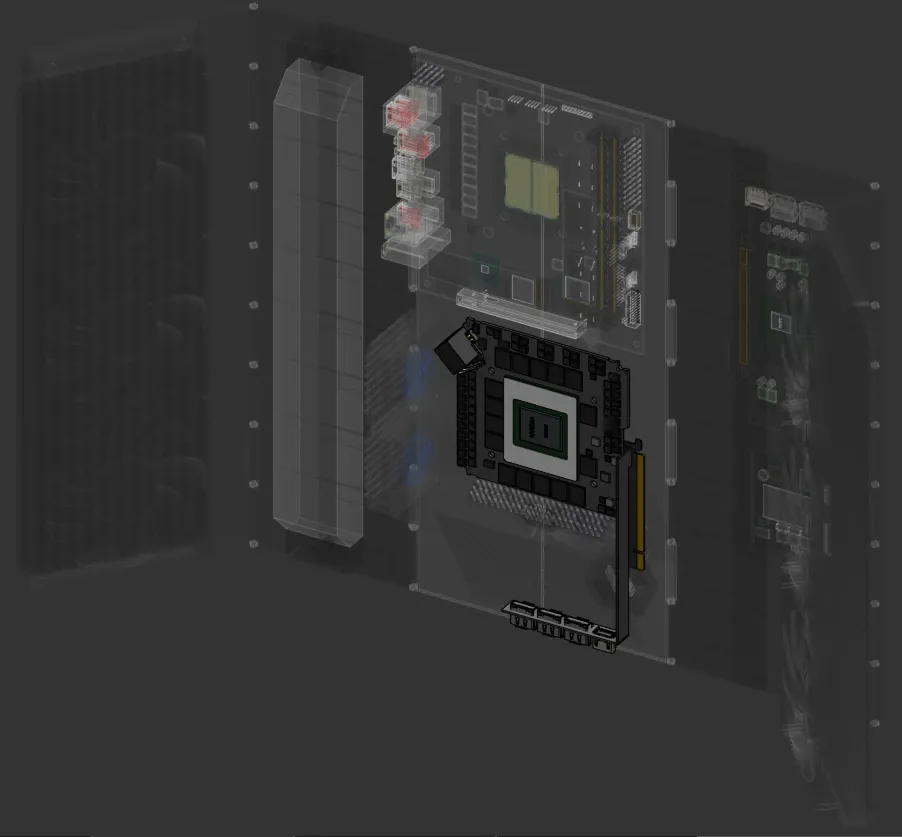
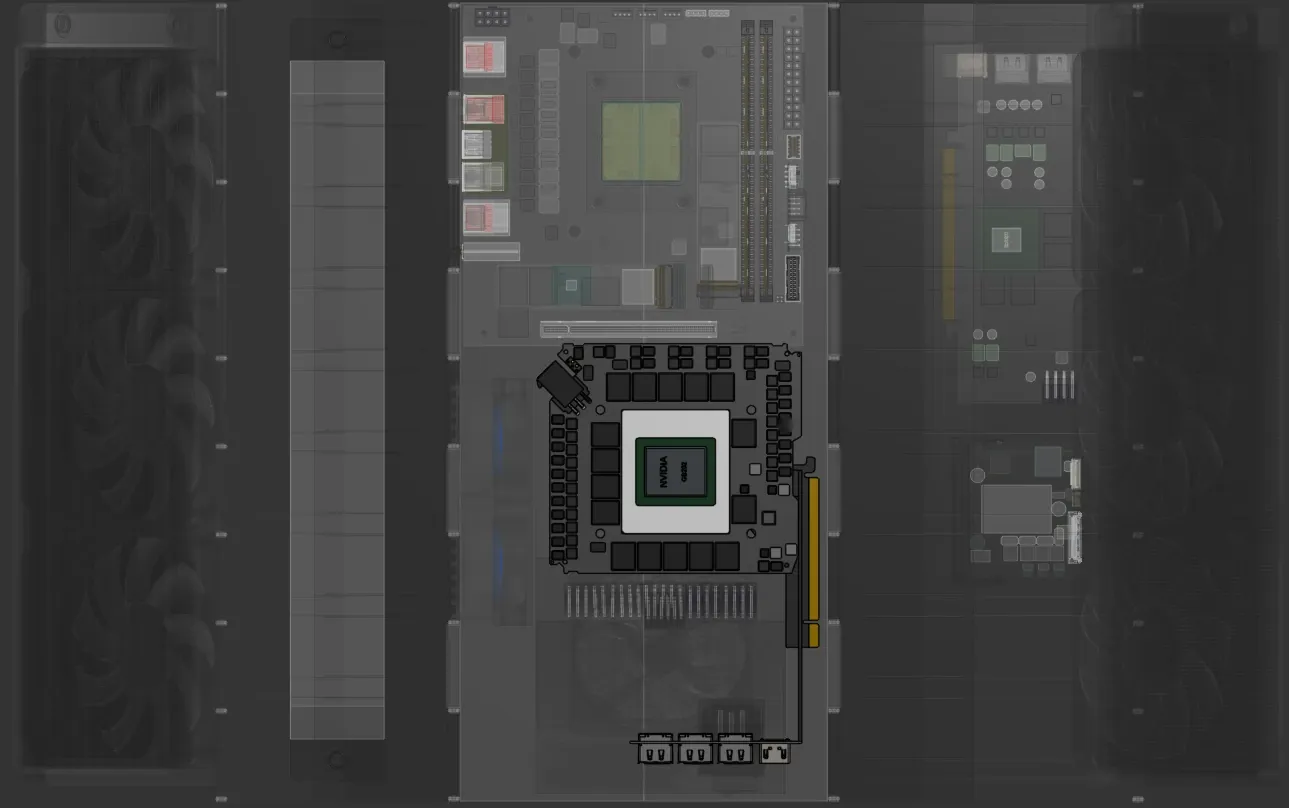
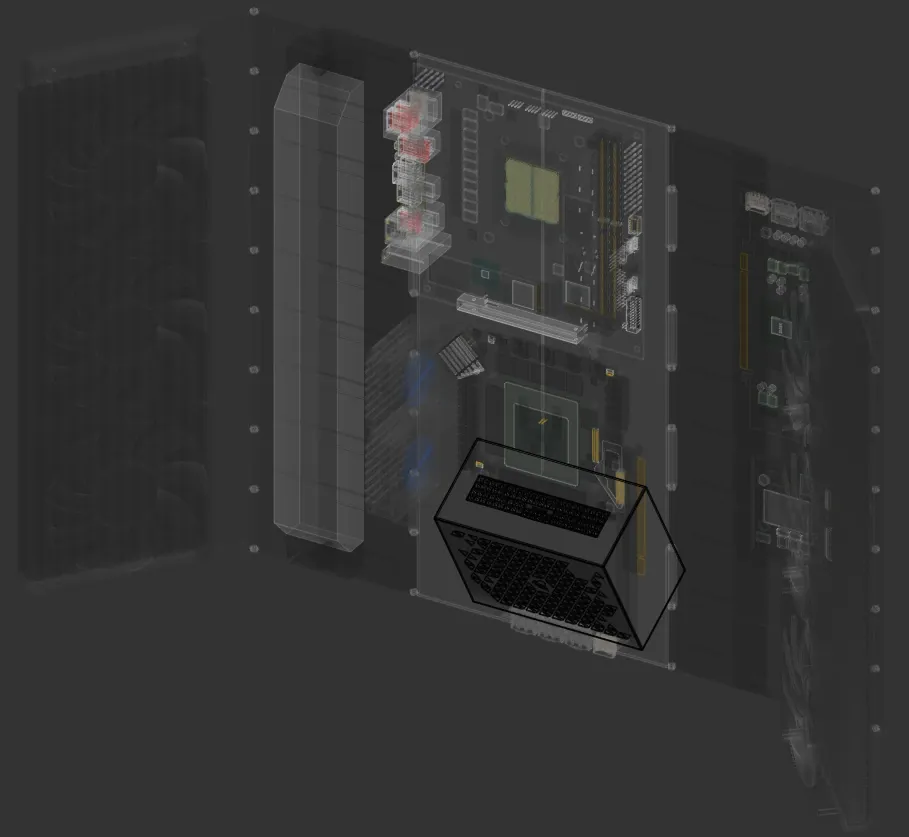
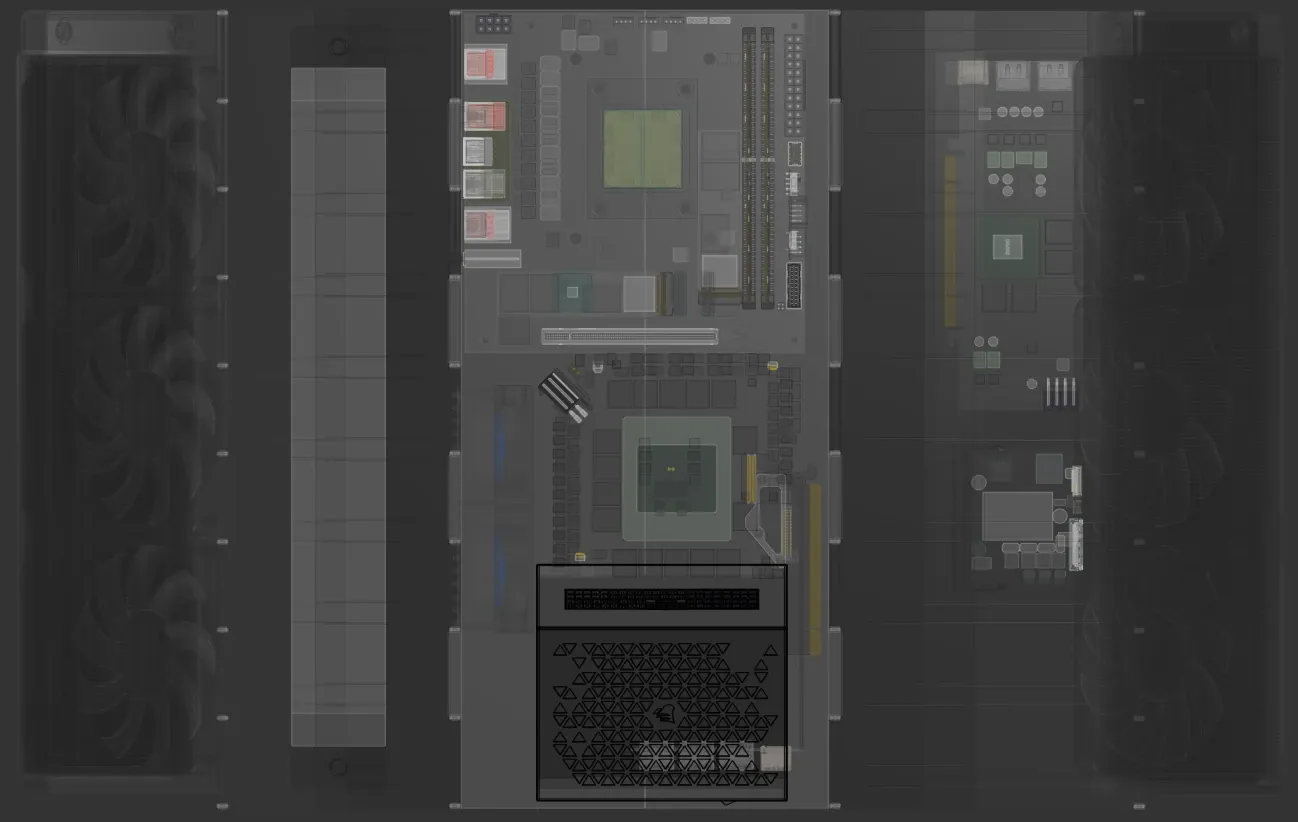
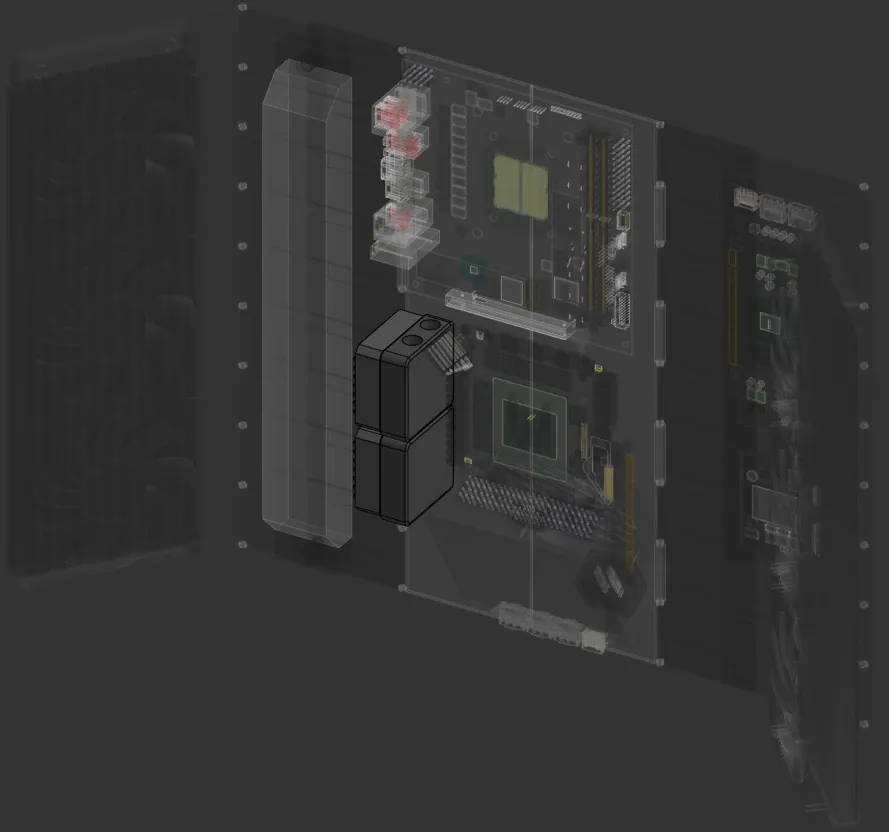
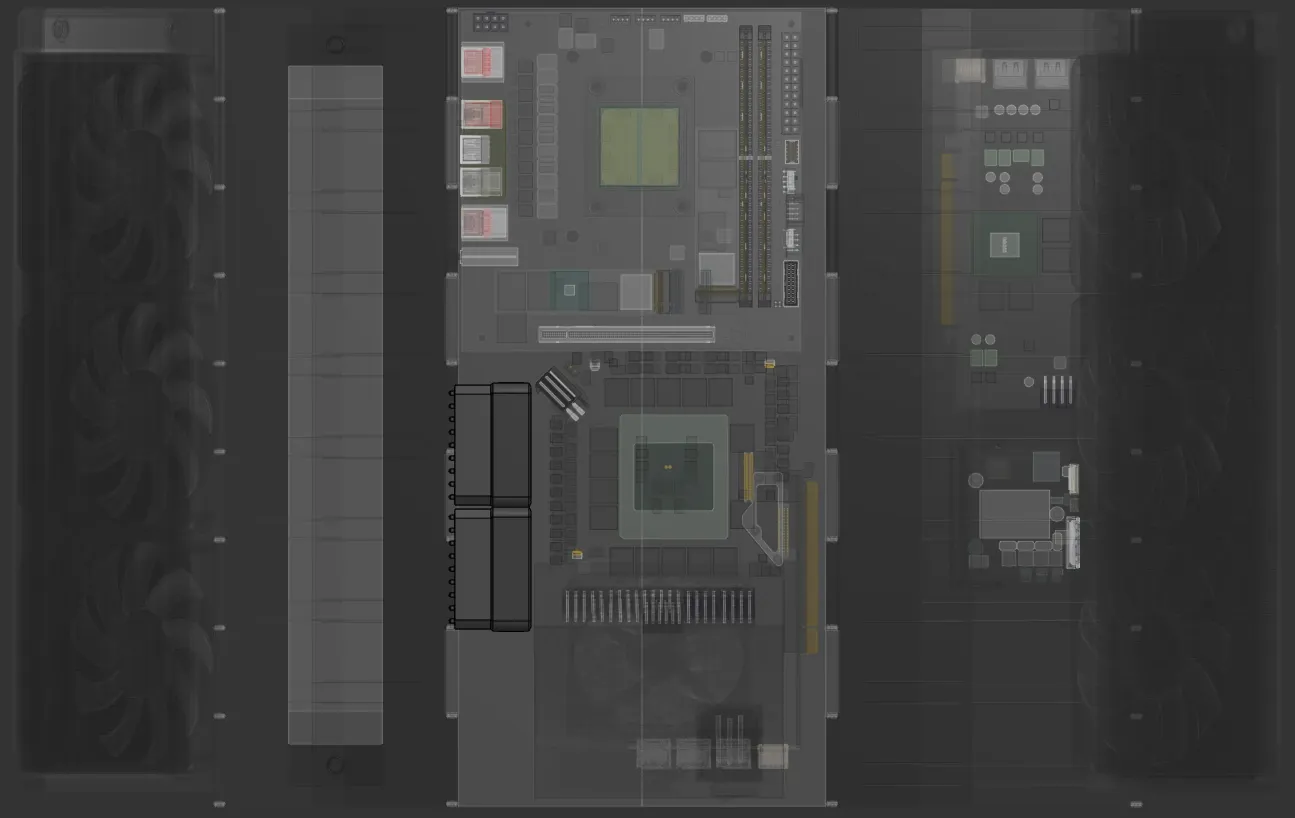
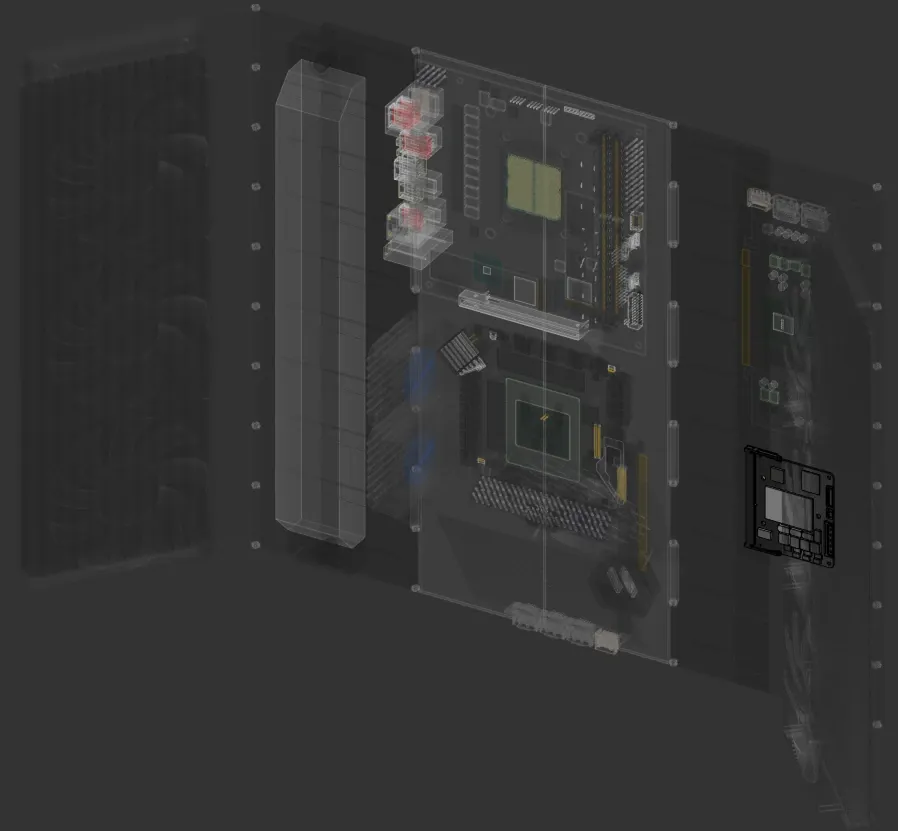
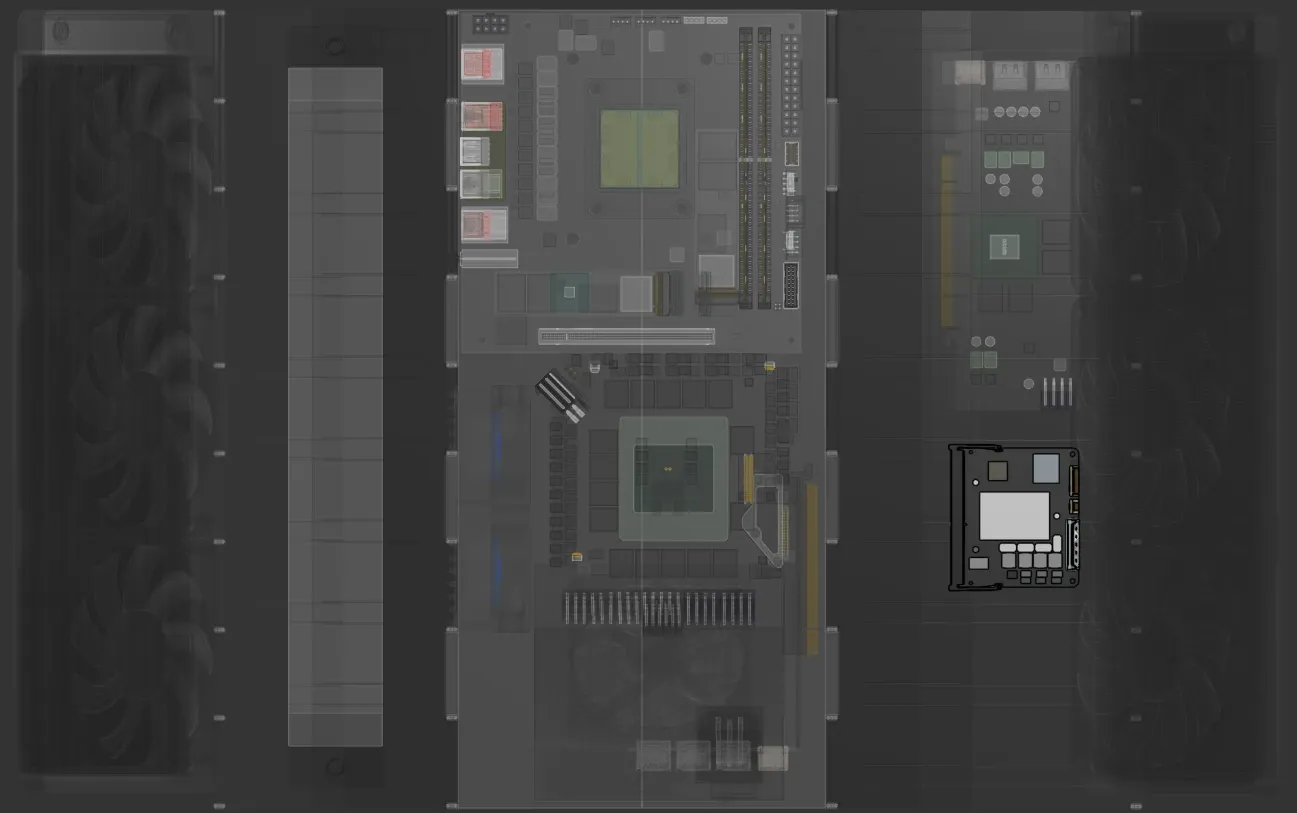
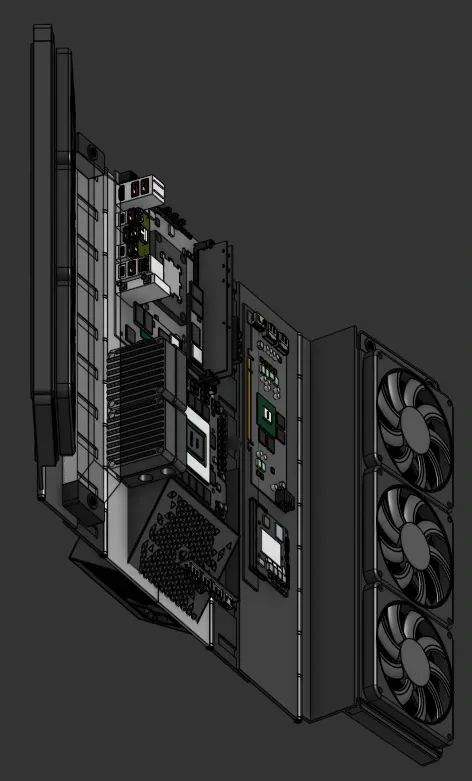
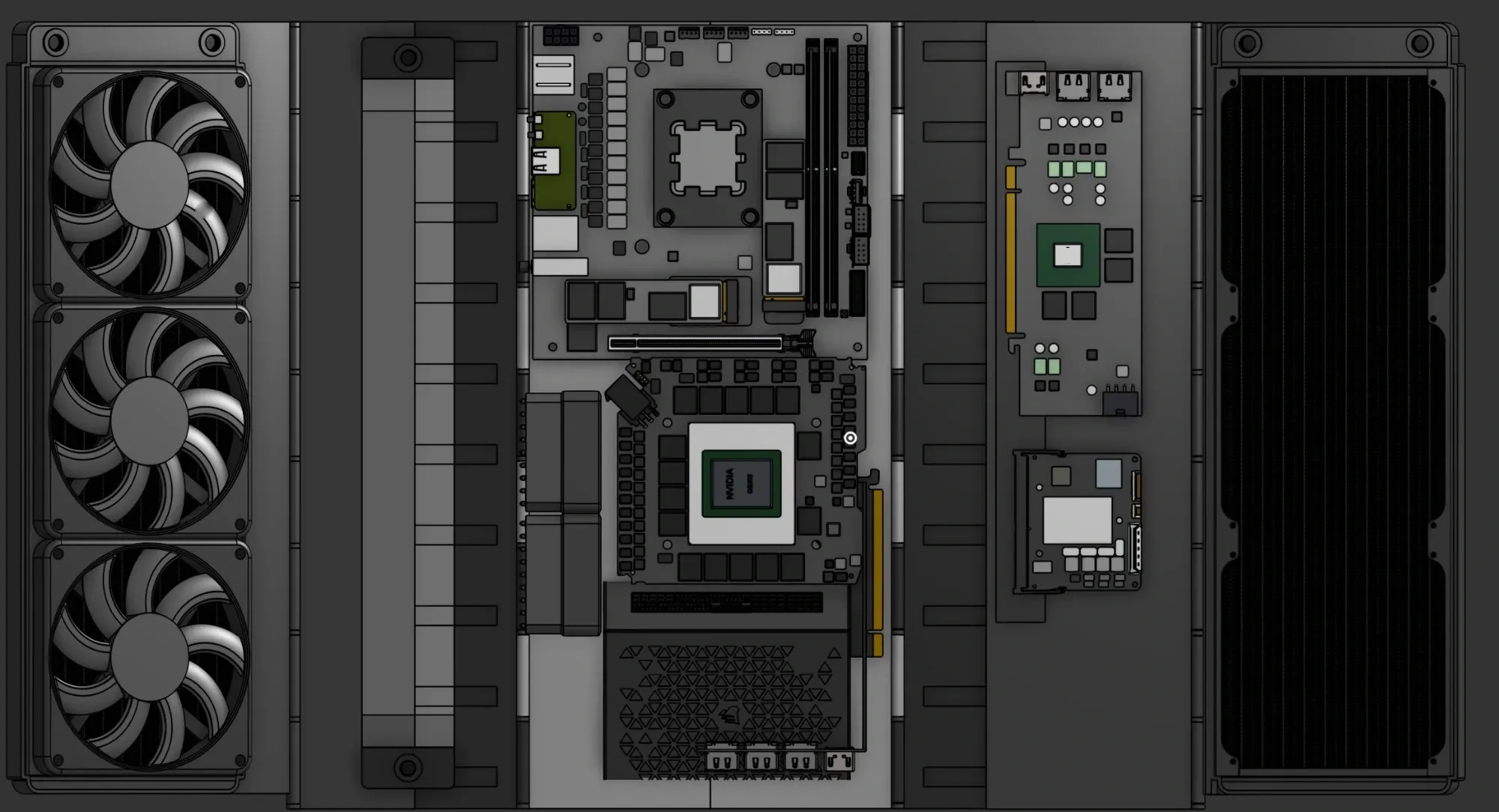
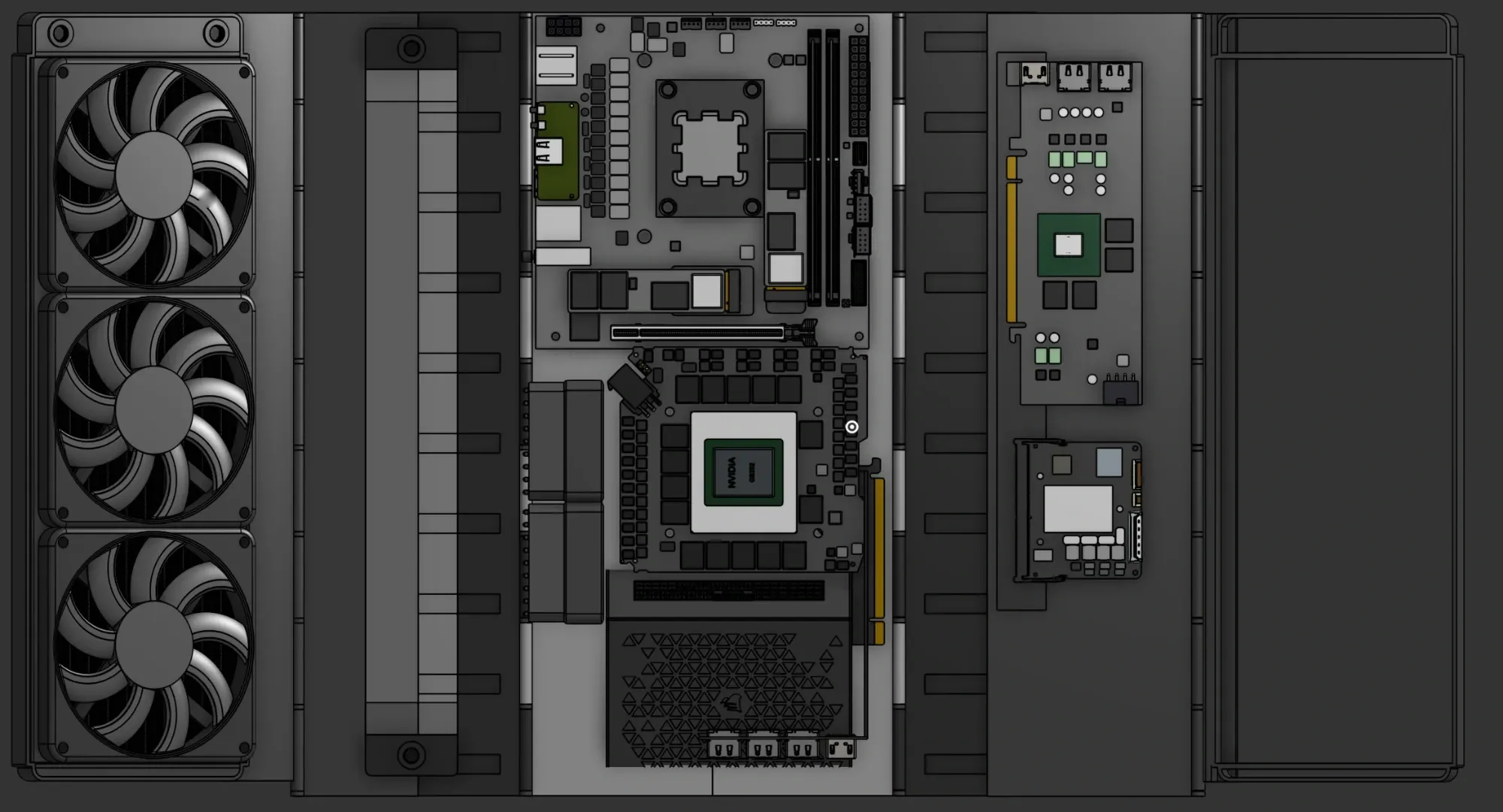
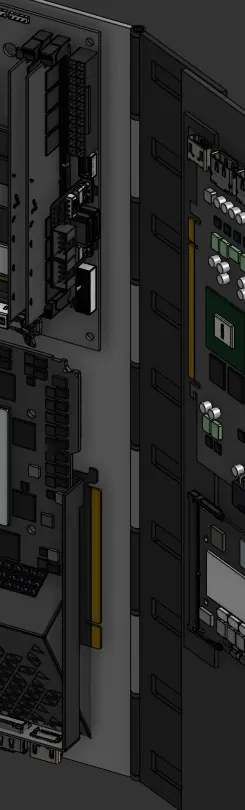
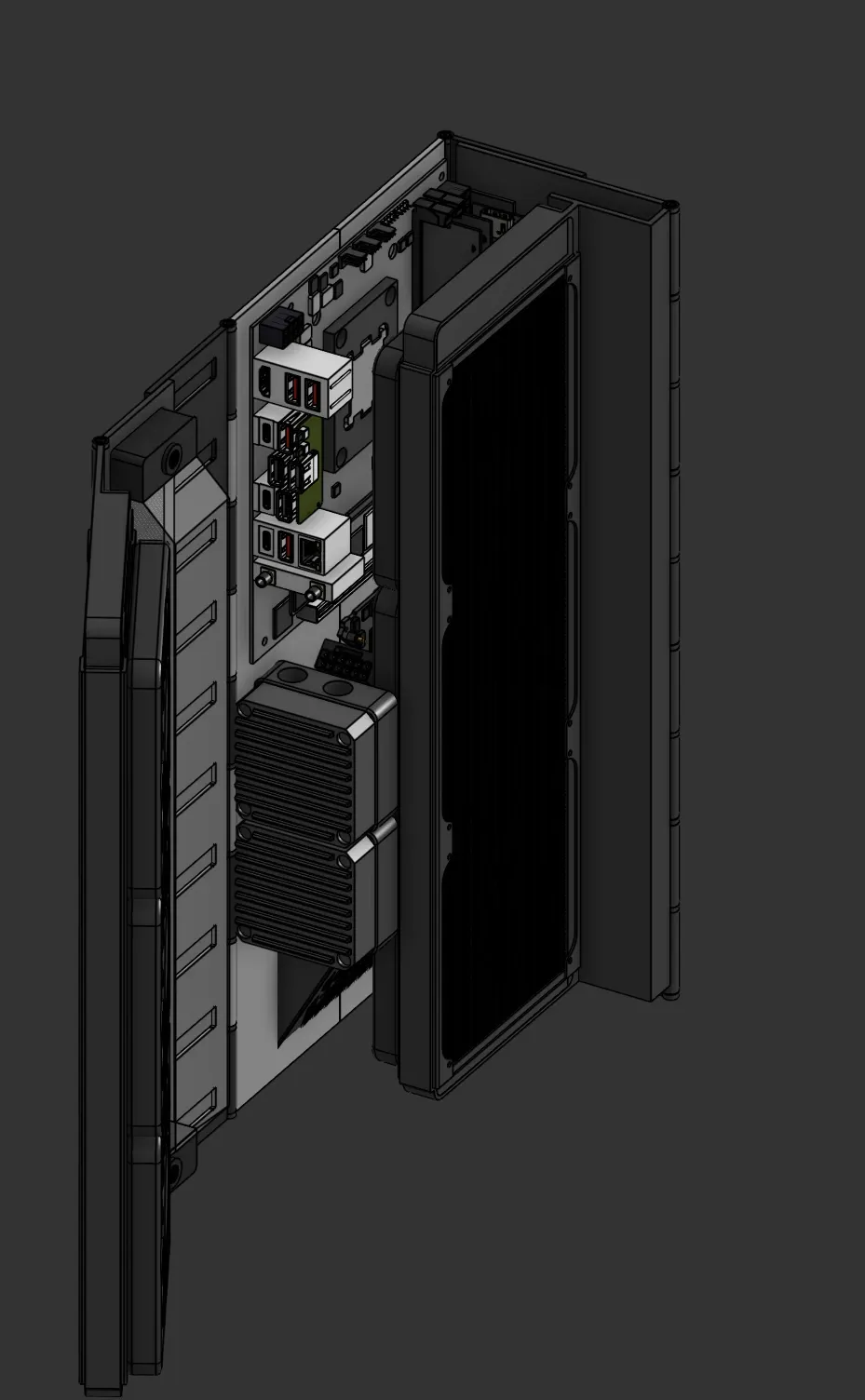
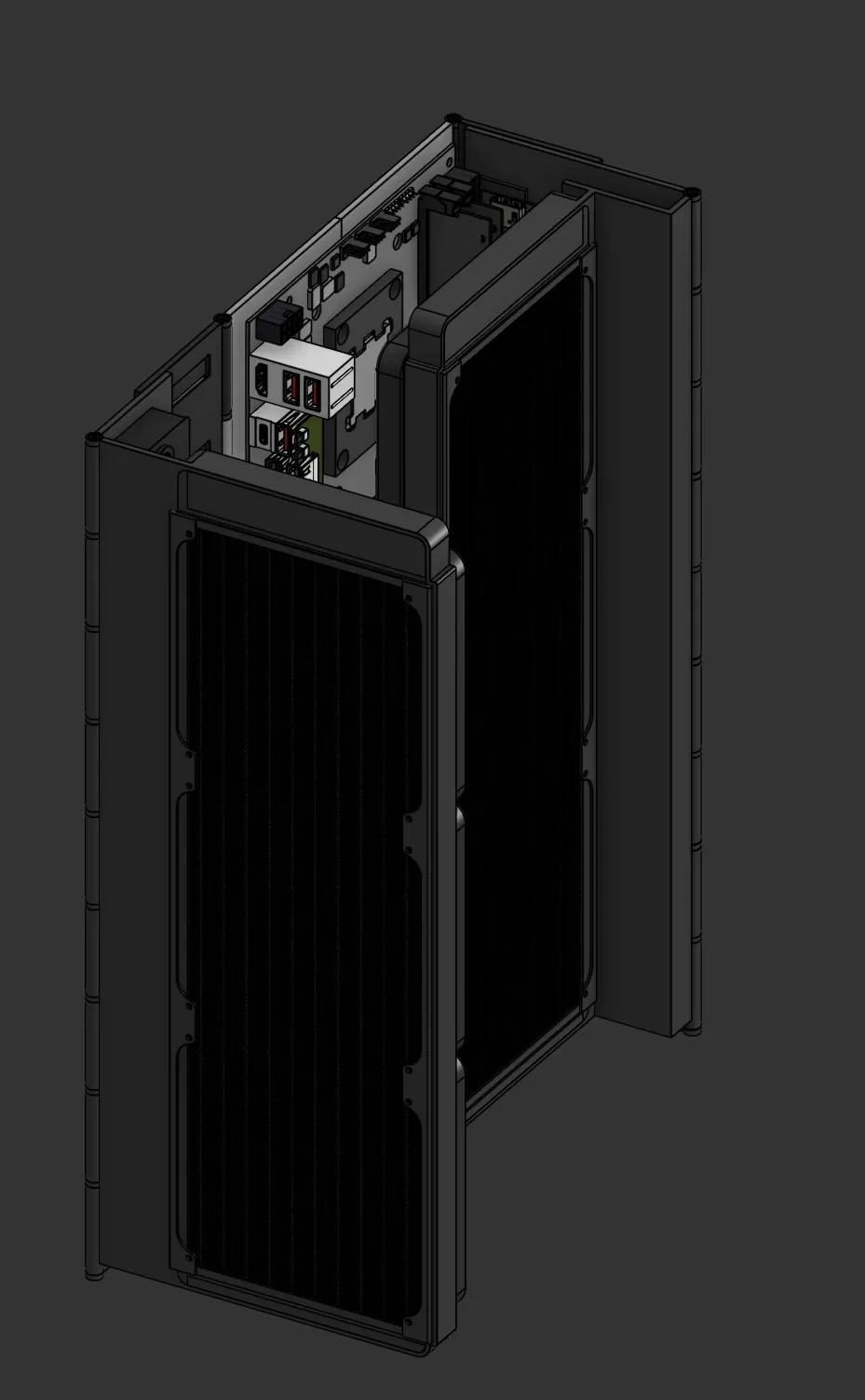
Three sections: a center backplate for the components, and a radiator wing on each side.

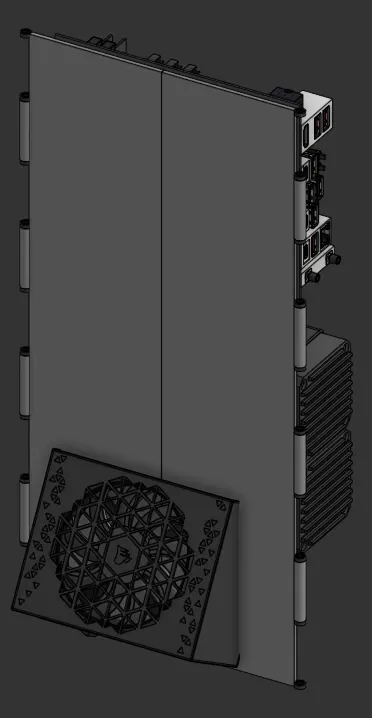
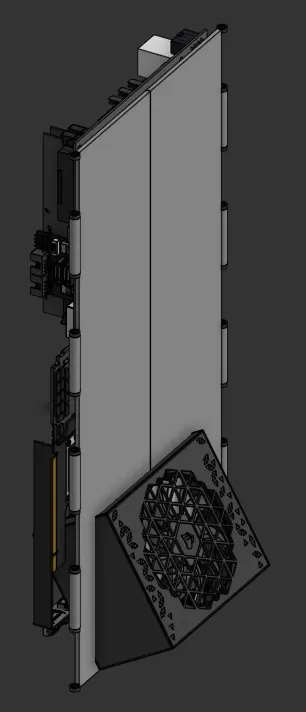
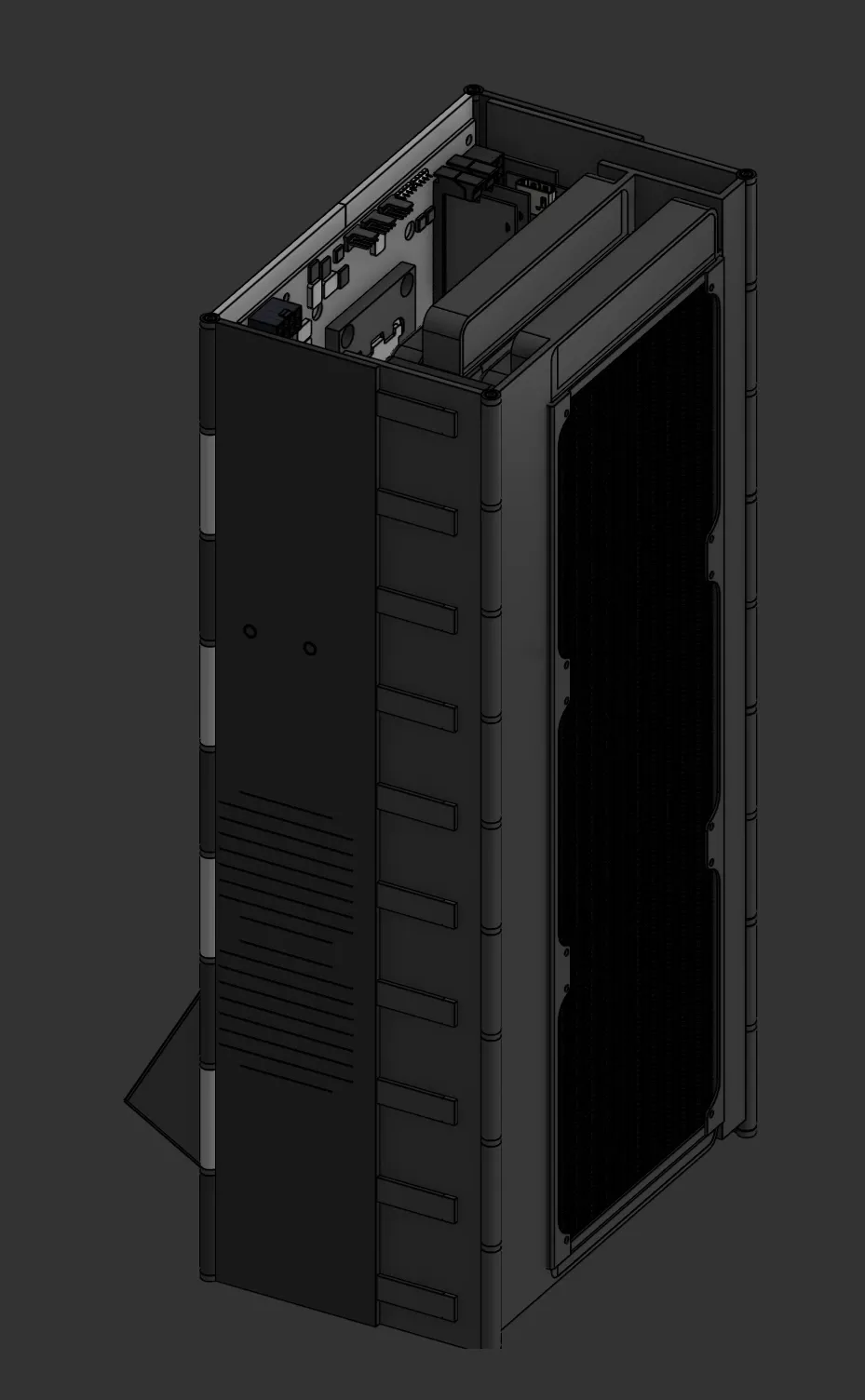
Closed
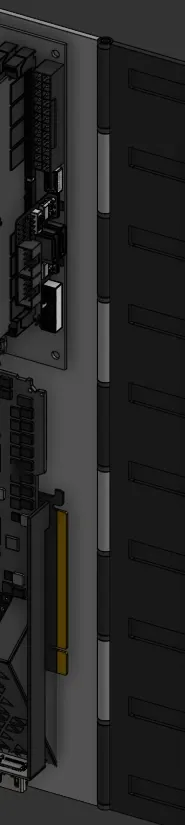
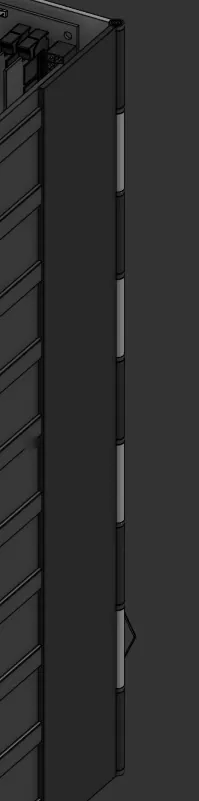
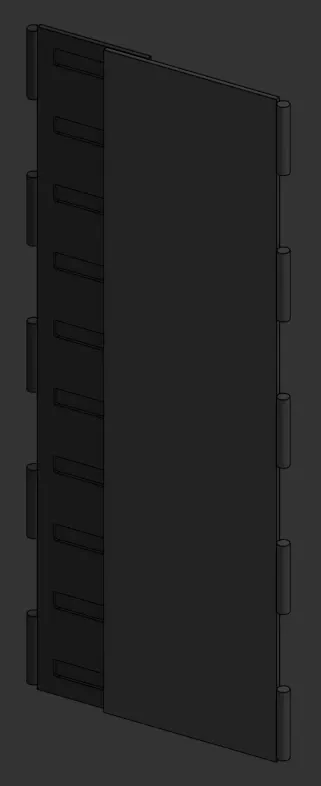
The radiators become the outer walls, and everything inside is protected.
The linkage
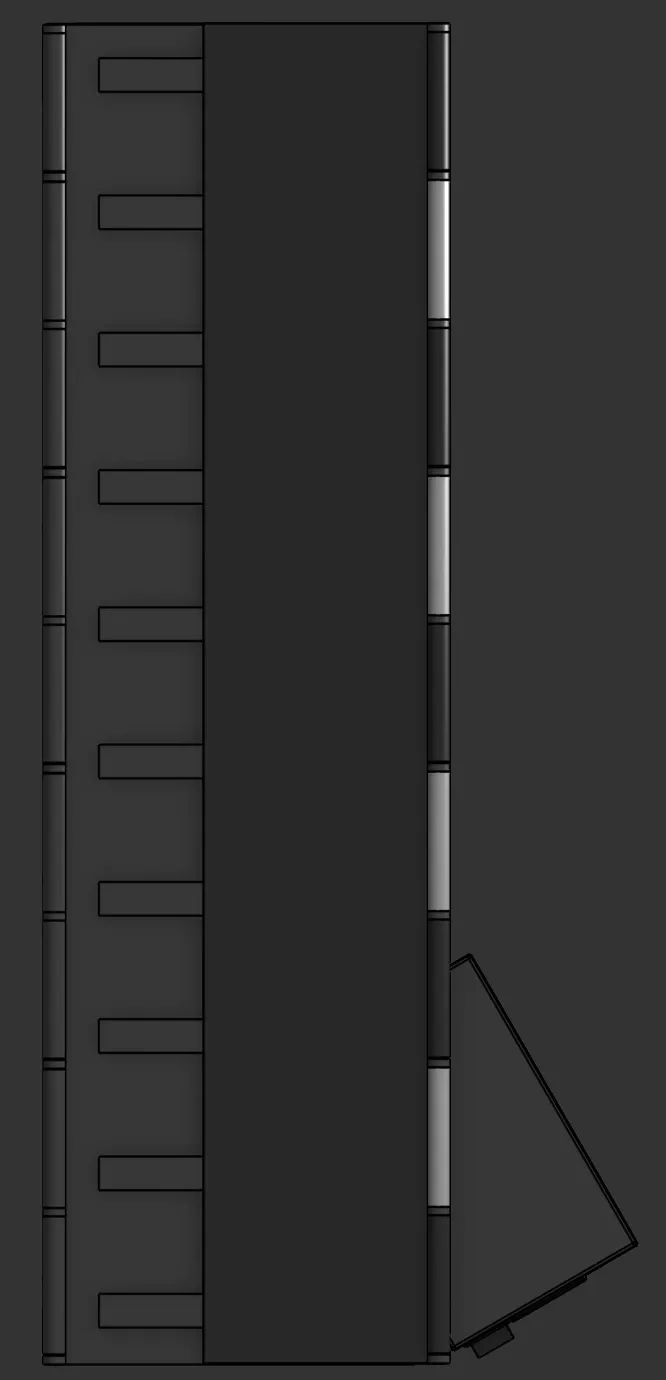
Two hinges with a slider between them, not one hinge, so each wing can wrap around the center and sit flush.
Open
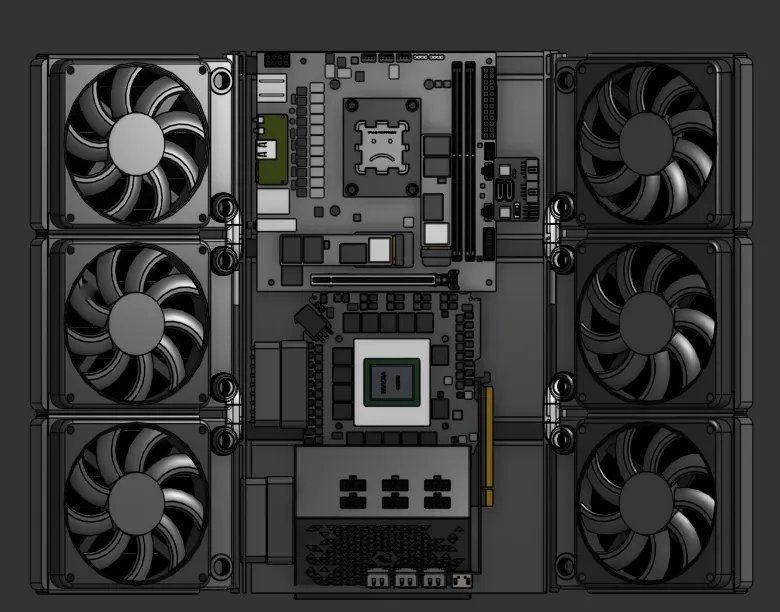
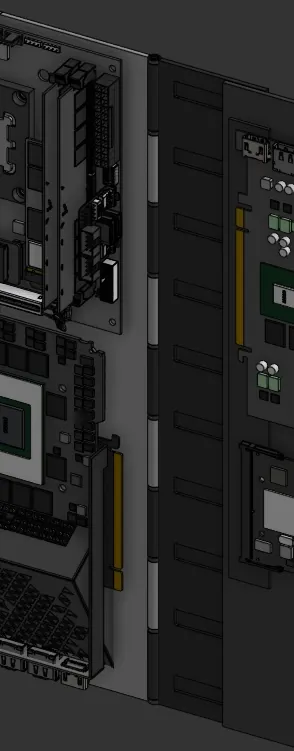
Each wing can lie flat, stand upright or sit anywhere between, closer to or farther from the center, so the case fits the space it’s in.

04Every millimeter counts

Materials

The 3 mm backplate carries nearly everything, and both ~1.2 kg wings hang off it. Every millimeter counts, so each part has to be strong and stiff at its minimum thickness, under 2-3 g handling loads.

Backplate

3 mm thick

Carbon fiberA wide, flat panel loaded in bending: for its weight, carbon is far stiffer than aluminum or titanium. Bonded inserts take the fasteners.

G10 fiberglassIsolates the boards from the conductive carbon and stops galvanic corrosion. A ground strap grounds the chassis.

Hinges

~2.2-2.5 mm arms

Grade 5 titanium, Ti-6Al-4VThe hinges carry each wing through arms only ~2.2-2.5 mm thick. Grade 5 titanium yields at roughly three times the stress of 6061 aluminum, so a thin arm stays strong (FEA to confirm), and threads tap straight into it, saving the room inserts would take.

SteelTitanium galls against itself when parts slide, so every bearing, pin and bushing is steel.

Wing frames

~1.2 kg per wing

TitaniumEach frame is an open shape that wraps the radiator, takes the knuckle bearing loads and twists when a wing is lifted. Carbon fiber can’t be bent into flanges or take point loads like that; titanium can. Bent flanges and ribs add stiffness without thickness, and the bolted-in radiator stiffens the frame further.

  • One wing, 1.2 kgRadiator ~0.65 kg + three fans ~0.26 kg leaves ~0.29 kg for the titanium frame and hinges.
  • Hinge loadAt 3 g, a wing pulls ~35 N on its hinges, through arms 2.2-2.5 mm thick.
  • Why titanium thereTi-6Al-4V yields at ~880 MPa, about 3.2× 6061 aluminum’s ~276 MPa, for 1.6× the weight.
3.8×The same panel, three materialsCarbon fiber is 3.8× stiffer than aluminum at the same weight. See the comparison

The center backplate is about 400 × 190 × 3 mm (228 cm³), estimated from the closed case’s 195 × 400 × 115 mm. The same panel in each material:

MaterialDensityPanel weightStiffness, same thicknessStiffness, same weight
Carbon fiber1.55 g/cm³0.35 kg0.72×3.8×
Aluminum 6061-T62.70 g/cm³0.62 kg1.00×1.0×
Titanium Ti-6Al-4V4.43 g/cm³1.01 kg1.65×0.4×

Stiffness relative to aluminum. Bending stiffness scales with E·t³; at equal weight the thickness scales with 1/ρ, so it goes with E/ρ³. Moduli: carbon laminate ~50 GPa in-plane, aluminum 69 GPa, titanium 114 GPa.

05The estimate

Cooling

Each wing carries a radiator and its fans. Two Laing DDC pumps move the coolant through flexible tubing that folds with the wings, and every major heat source is water-cooled.

Thermal calculations

  • Coolant over room airΔT = Q / UA = 1,100 W ÷ 30-35 W/°C31-37 °C, so about 56-62 °C coolant in a 25 °C room.
  • Warming across the loopΔT = Q / (ṁ·c) = 1,100 W ÷ (0.063 kg/s × 4,186)4.2 °C from the coldest point to the hottest, at 3.75 L/min.
  • A short peak250 W extra ÷ (0.37 kg × 4,186)0.16 °C per second, counting only the reservoir’s water: about 6 s per degree. The rest of the coolant and the copper slow it further.
Can two thin radiators handle it? The test data
  1. Need

    The pumps are rated for coolant up to 60 °C: a 35 °C budget in a 25 °C room. 1,100 W across 35 °C needs 31.4 W/°C: 15.7 W/°C per radiator.

  2. Test

    TechPowerUp tested this exact radiator, the XSPC TX360, at 1 GPM in a 25 °C chamber, on a 550 W overclocked system.

  3. Check

    At 800 rpm, with less airflow than a P12 Slim, the coolant sat 14.7 °C above the air. Falling short would mean under 231 W reached the loop: less than half the system’s draw. One TX360 covers its half with margin.

One XSPC TX360, tested by TechPowerUpCoolant above room air, in °C, at each fan speed. Shorter is better.
  1. 16.2600
  2. 14.7800
  3. 11.751,200
  4. 9.31,500
  5. 8.351,800
  6. 7.552,000
  7. 7.32,200

Fan speed, rpm

Sources and method

At 800 rpm the test fan is rated 57.3 m³/h; a P12 Slim at full speed, 71.5 m³/h. TechPowerUp used 25 mm Noiseblocker eLoop fans and the P12 Slim is 15 mm, so the two are compared by rated airflow only. Sources: TechPowerUp, XSPC TX360 review: thermal performance; Alphacool, Laing DDC pump: water 10-60 °C; Aqua Computer, Noiseblocker eLoop B12-1: 800 rpm, 57.3 m³/h; Aquatuning, Arctic P12 Slim PWM PST: 2,100 rpm, 71.53 m³/h.

Cooling parts: radiators, fans, pumps, reservoir and loop
Radiators
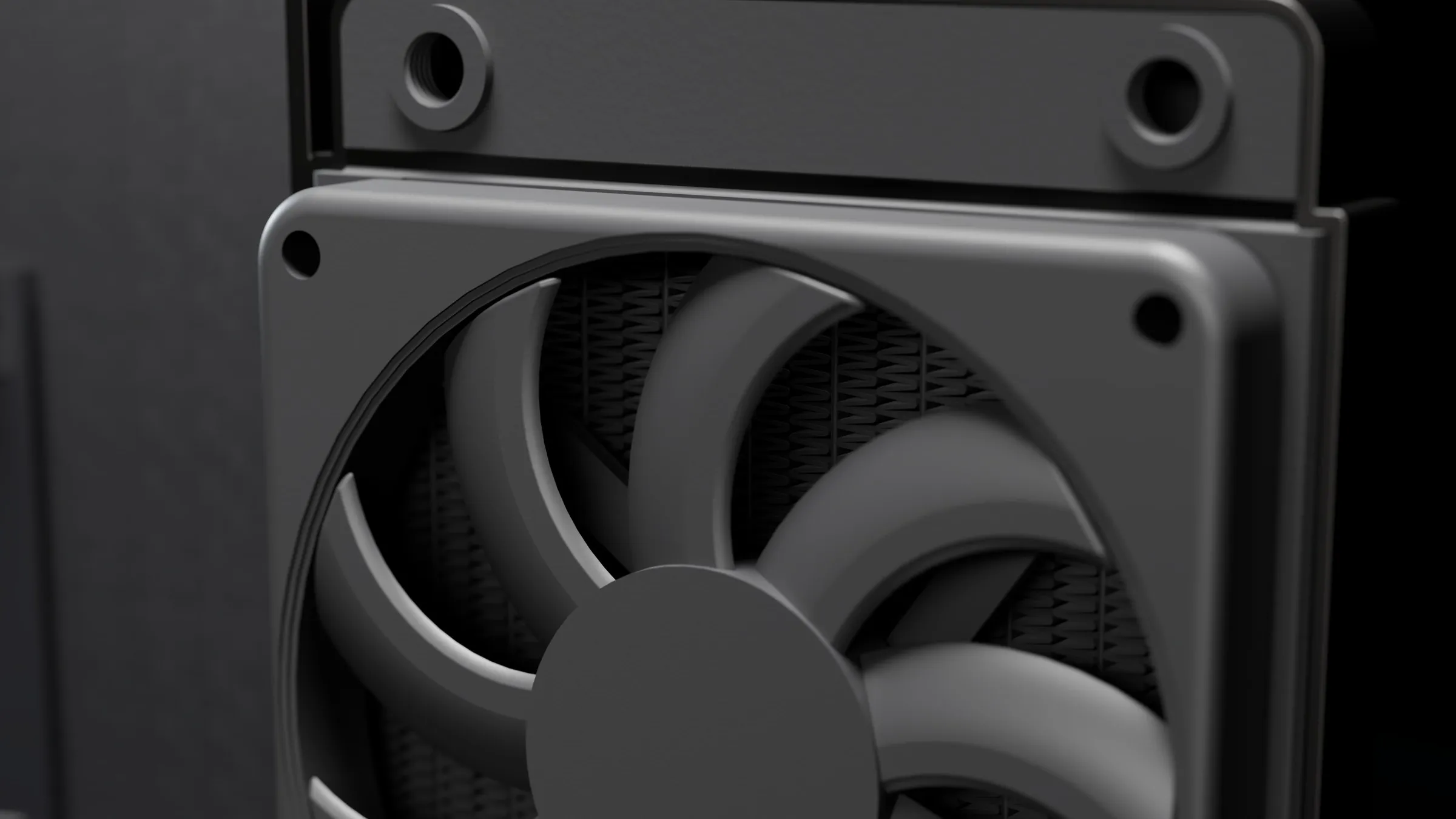
ModelXSPC TX360 ultra-thin
Count2
Size125 × 20.5 × 398 mm
Core16 mm
Fin density22 FPI
MaterialCopper and brass
Fans
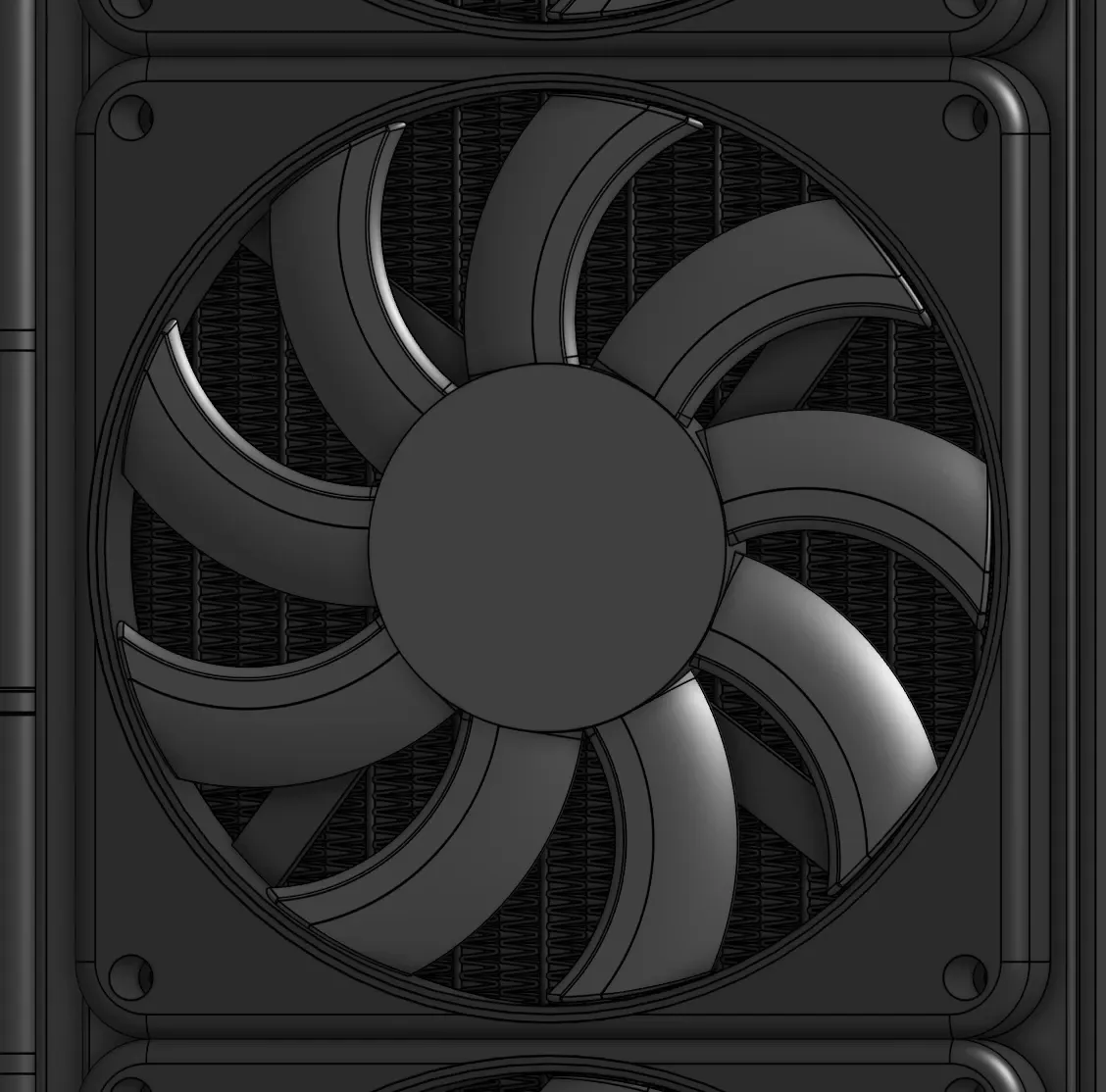
ModelArctic P12 Slim
Count6
Per radiator3
Thickness15 mm
Max speed2,100 rpm
Airflow, each71.5 m³/h
Pumps
ModelLaing DDC 4.2 PWM
Count2
Voltage12 V
Max power, each20 W
Speed1,000-4,500 rpm
Max flow, each517 L/h
Max head4.34 m
ArrangementIn series
Reservoir
Outside340 × 47 × 33 mm
Wall3 mm
Inside volume~370 mL
Loop
LayoutOne series loop
OrderReservoir → pumps → RTX 5090 → LattePanda Mu Ultra → RTX 5060 → right radiator → CPU → left radiator
Flow, operating~3.5-4 L/min
Restriction, whole loop~1.08 bar
Pumps, deadhead in series~1.15 bar
Flow sensorHard shutdown on low flow
TubingFlexible
Through-board tube, OD / ID4.5 / 3.5 mm
Through-board tubeCopper, PTFE sleeve

06Cooling

Waterblocks

Every major heat source is water-cooled. The radiators are on the wings, so all of the heat has to get into the loop to reach them.

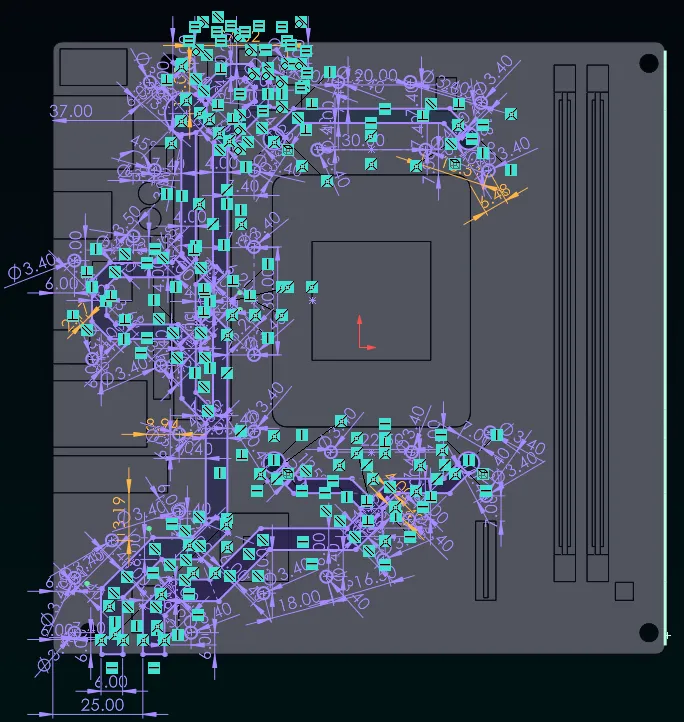
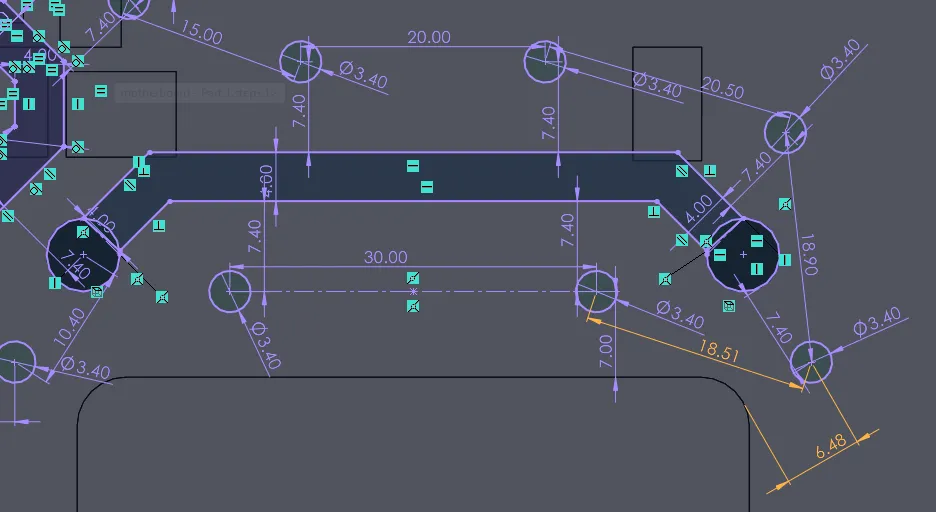
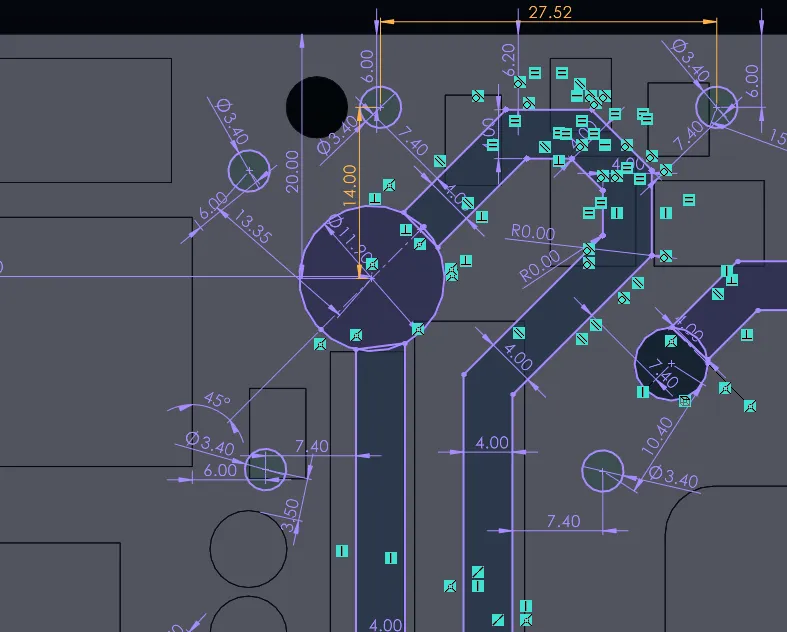
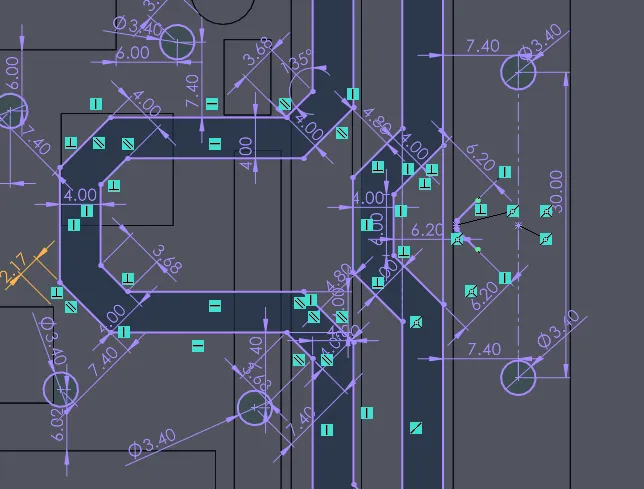
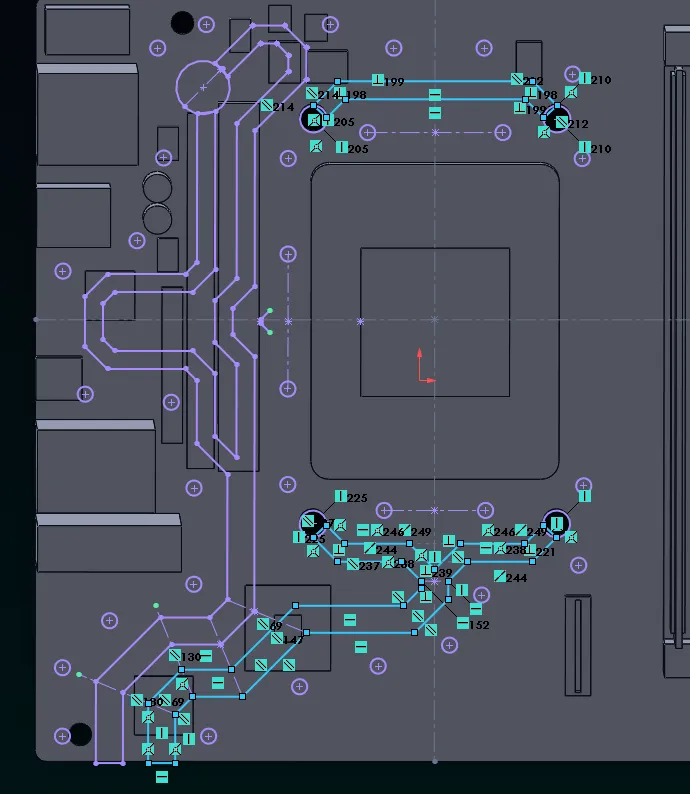
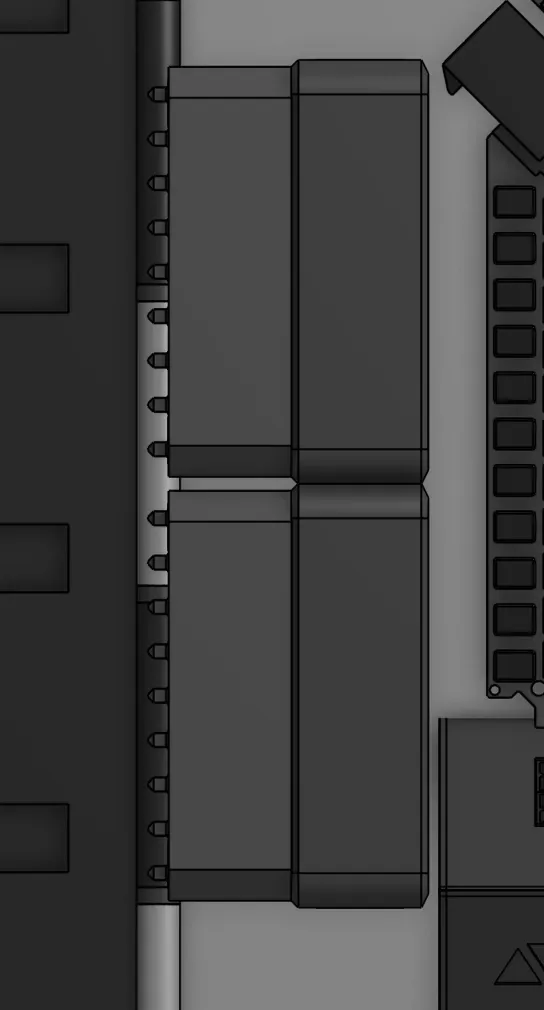
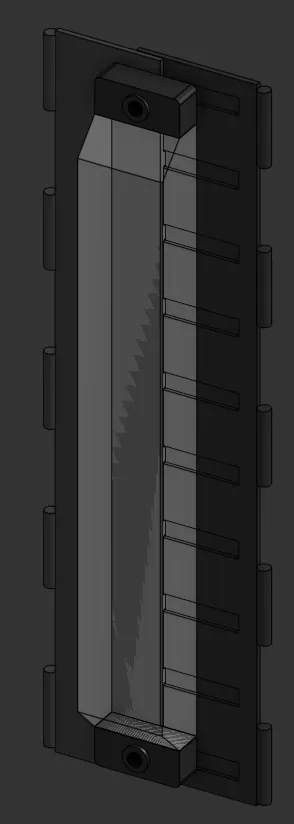
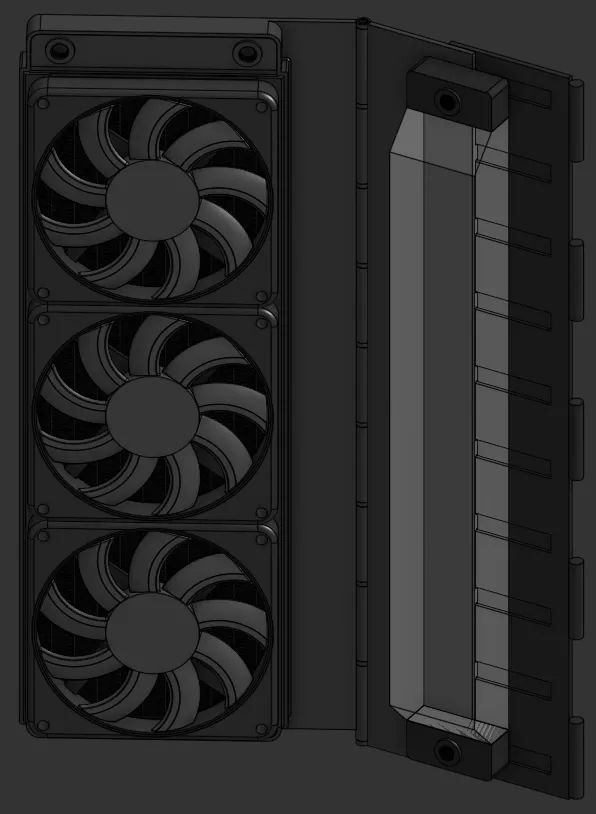
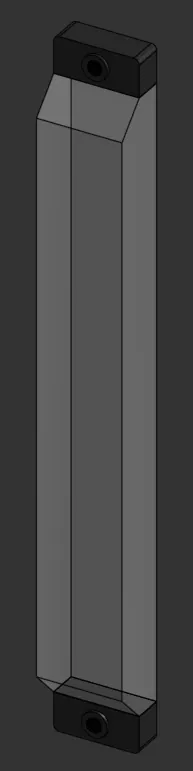
In progress. The CPU monoblock is the first block, and it’s still being designed. Every screenshot in this section is of the monoblock.

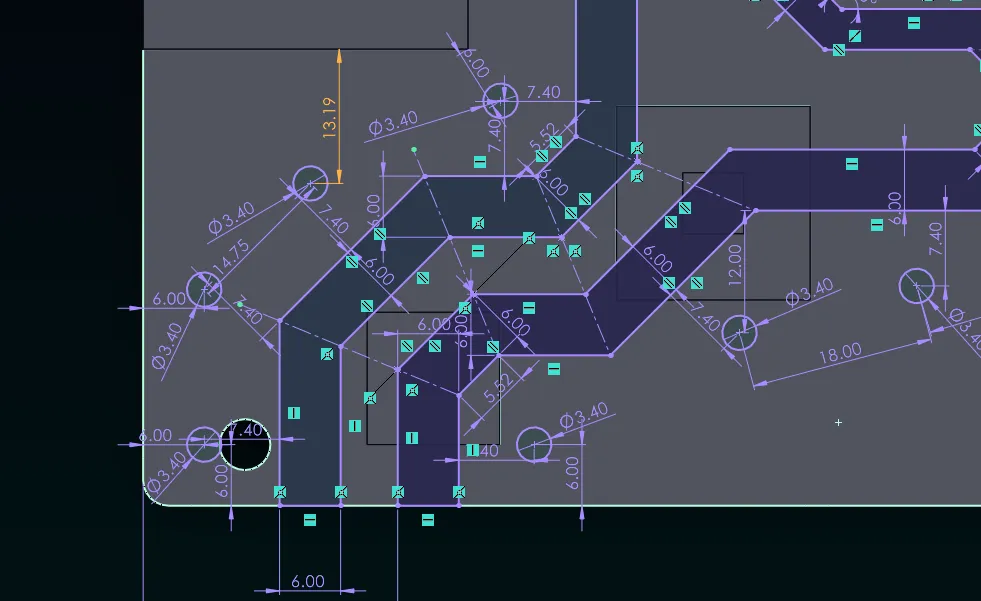
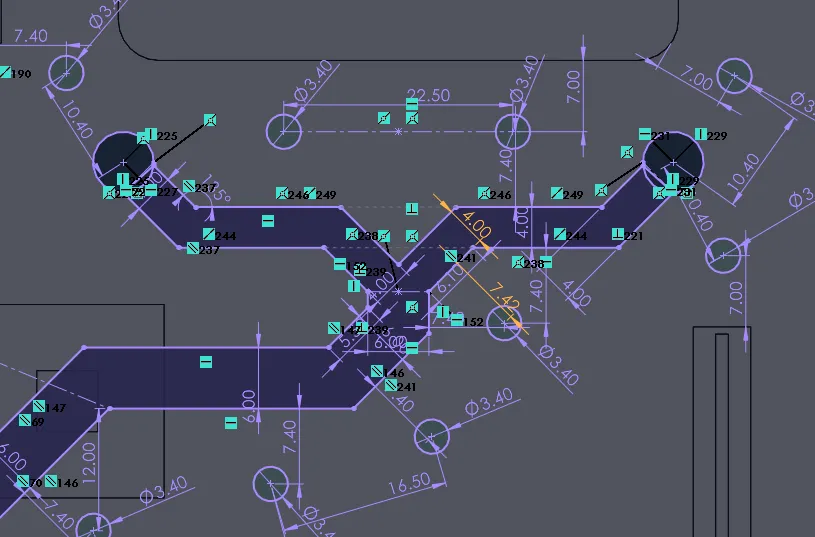
Fully dimensioned

The numbers behind it

  1. Split the flow

    v = Q / A · Dₕ = 4A / P

    At 3.75 L/min, one 4.0 × 3.5 mm channel would run at 4.5 m/s. Two branches carry half each: 2.2 m/s, Dₕ 3.7 mm. The 6.0 × 3.5 mm trunk takes the full flow at 3.0 m/s, Dₕ 4.4 mm. Re ≈ 9,000-15,000: turbulent throughout.

  2. Velocity squared

    ΔP = (f·L/Dₕ + ΣK) · ρv²/2

    Halving the velocity cuts each velocity head (ρv²/2) to a quarter: ~2.5 kPa in a branch against ~10 kPa in a single channel. Block total: ~0.38 bar.

  3. Bend radii

    K(sharp 90°) ≈ 1.1 → K(r/Dₕ ≈ 1) ≈ 0.3

    Minor losses dominate at these velocities. An R4 centerline on the branches and R6 on the trunk (R2 / R3 inner) cut the first estimate of 0.7 bar nearly in half, with no change in channel size.

  4. Jet plate

    A = 25 × 0.475 mm → v ≈ 5.3 m/s, ρv²/2 ≈ 0.14 bar

    The single slot fires coolant onto the microfins at about two velocity heads: ~0.3 bar. The block’s biggest restriction, on purpose: pressure traded for heat transfer.

  5. Gap cubed

    Q_bypass = w·h³·ΔP / (12·μ·L)

    Leakage around the jet plate goes with the gap cubed. At the 0.1 mm target, a 0.05 mm error changes bypass 8×, so the Ni-P plating (10-12 µm) is in the tolerance stack and the slots are cut oversized.

  6. Operating point

    ΔP_pumps(Q) = ΔP_loop(Q)

    Two DDCs in series add their heads: ~1.15 bar at zero flow, against ~1.08 bar for the whole loop at ~3.5-4 L/min. One pump alone deadheads near ~0.58 bar, below the loop’s restriction, so it would barely move coolant. The second pump carries load, and a flow sensor with a hard shutdown is required.

Each block, and how the monoblock is made
The blocks
CPU monoblockC145 copper under an acrylic top, with split-and-merge channels and a brass jet plate over the CPU.
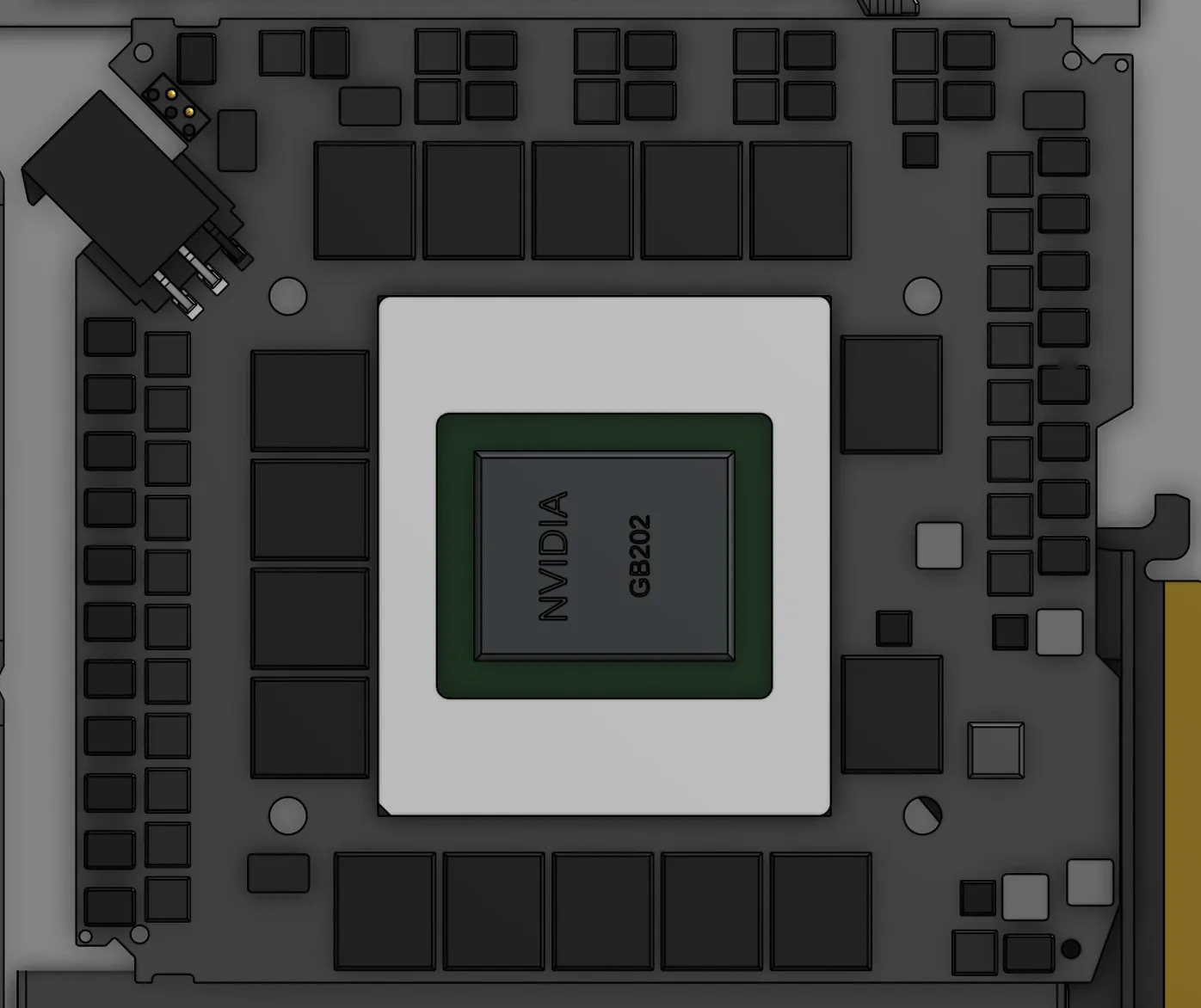
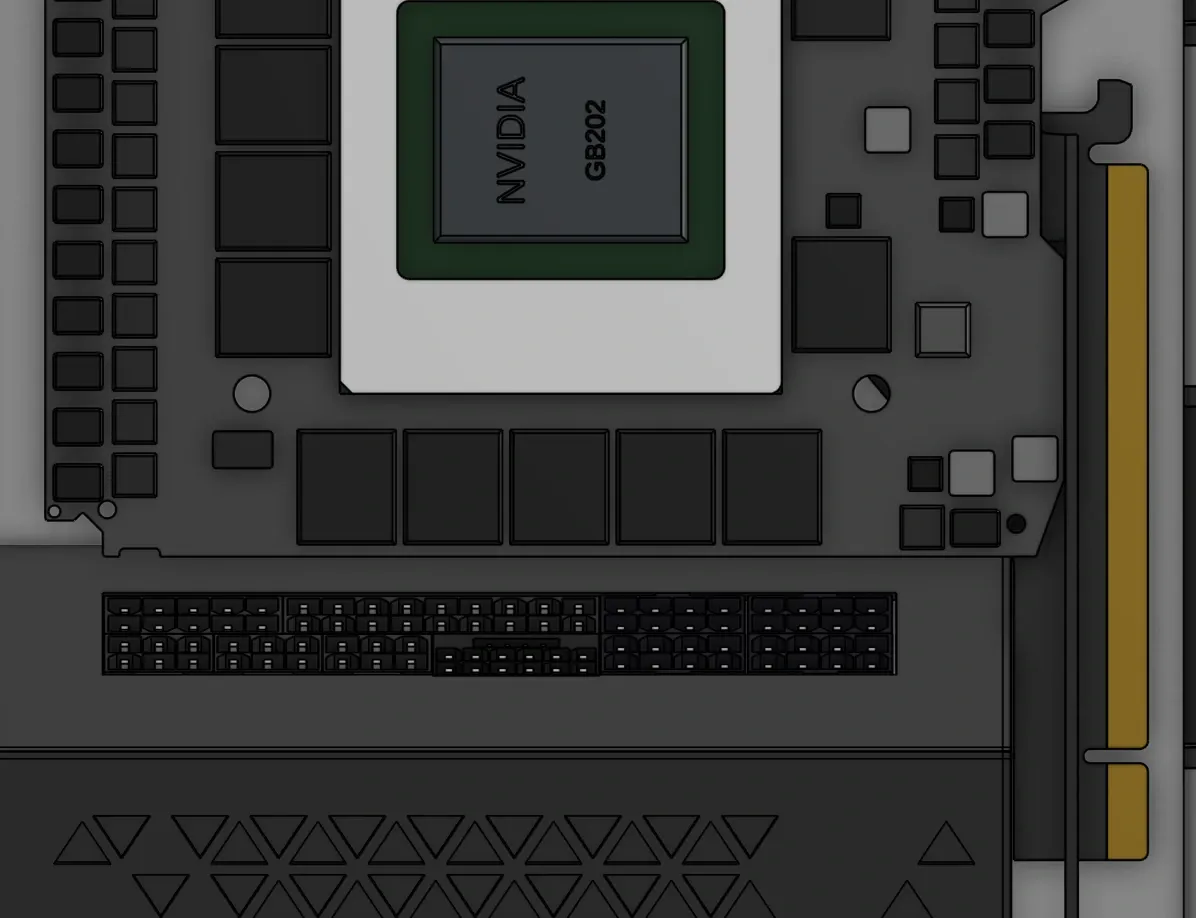
RTX 5090The largest heat source, at ~575 W stock. A pedestal inside the Founders Edition’s brace window bridges ~1.0-1.2 mm from the GDDR7 tops to the die.
RTX 5060The secondary system’s GPU, at ~145 W stock.
LattePanda Mu UltraThe secondary system’s compute module, at ~30 W stock.
How the monoblock is made
DesignModeled in SolidWorks.
BodyC145 tellurium copper, under a cast acrylic (PMMA) top.
PlatingElectroless nickel (Ni-P) per ASTM B733, mid-phos, 10-12 µm.
ChannelsSplit and merge: two 4.0 × 3.5 mm branches into a 6.0 × 3.5 mm trunk, 6.5 mm block, ~7.5-8 mm at the port boss.
Jet plateC360 brass, cut by wire EDM. A three-piece stack with a swappable 0.58 mm spacer sets a 0.10 mm standoff gap.
SealA 2.0 mm O-ring cord in a 2.70 × 1.50 mm groove. M3 A2 stainless screws with nylon washers sit outboard of the seal.
Thermal interfaceThermal Grizzly KryoSheet on the CPU and GPU, Laird Tflex pads elsewhere.

07Hardware

Two computers, one case

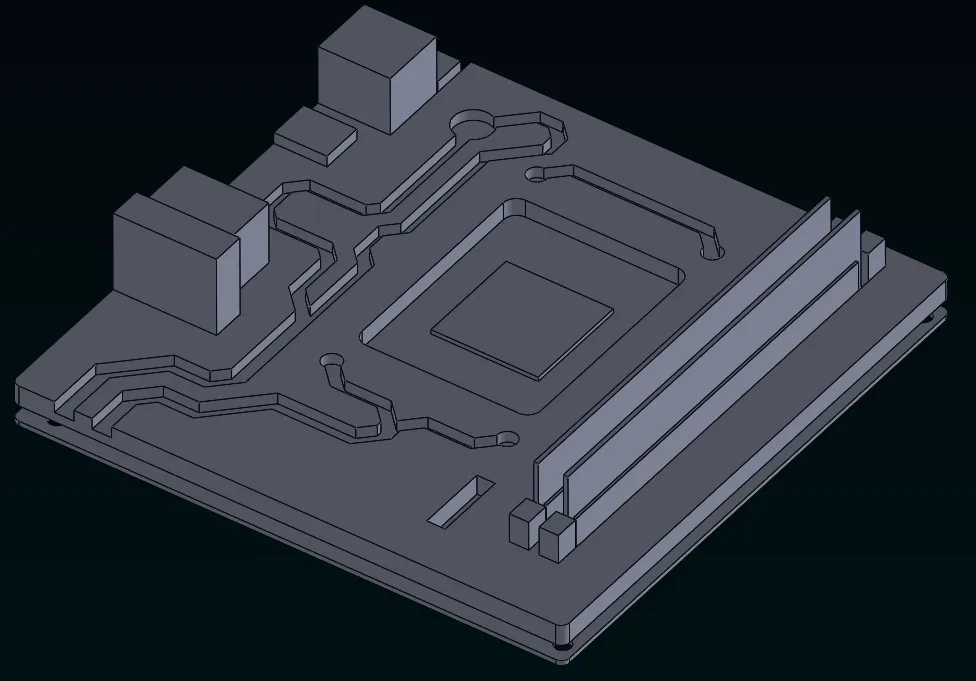
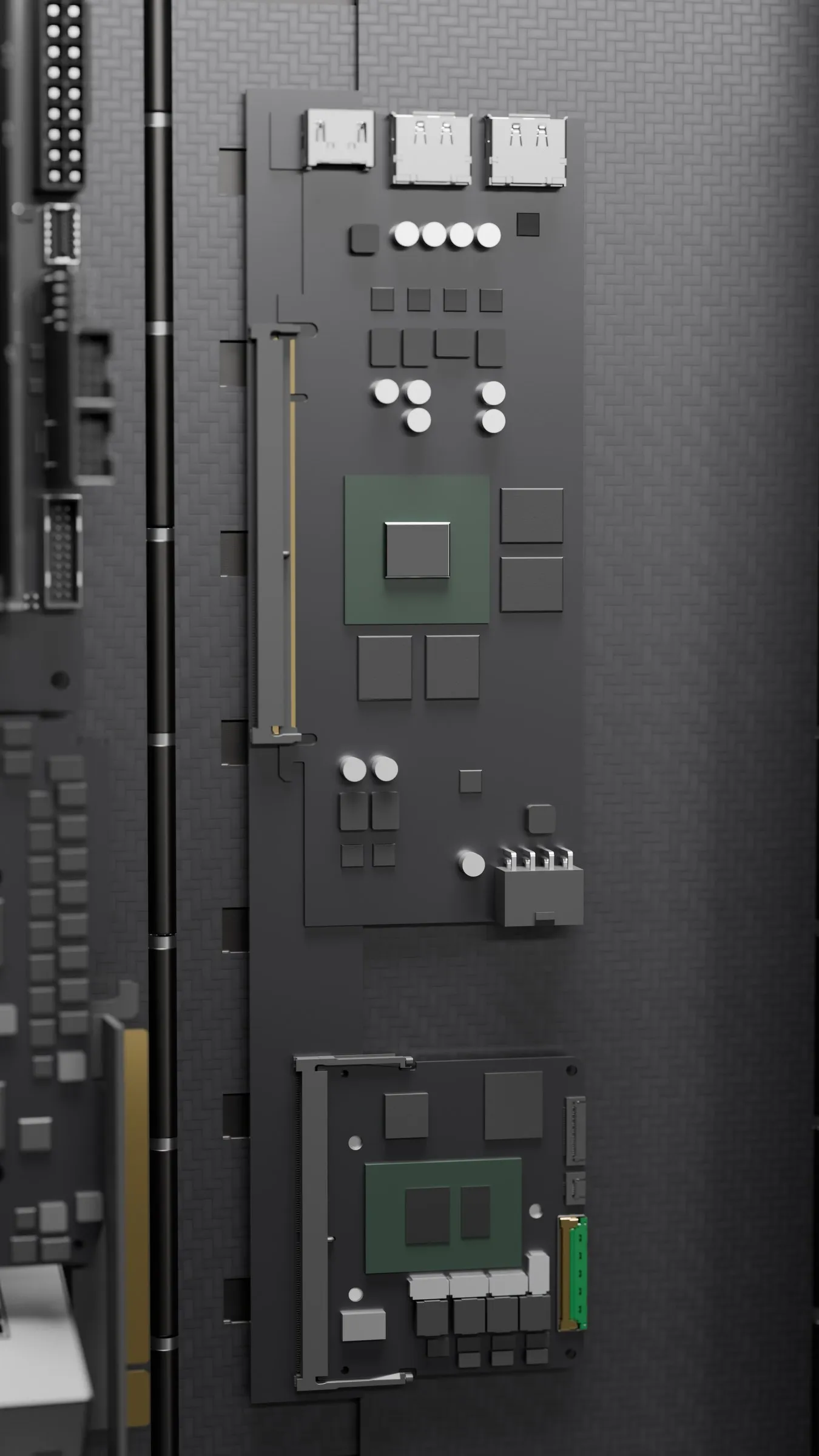
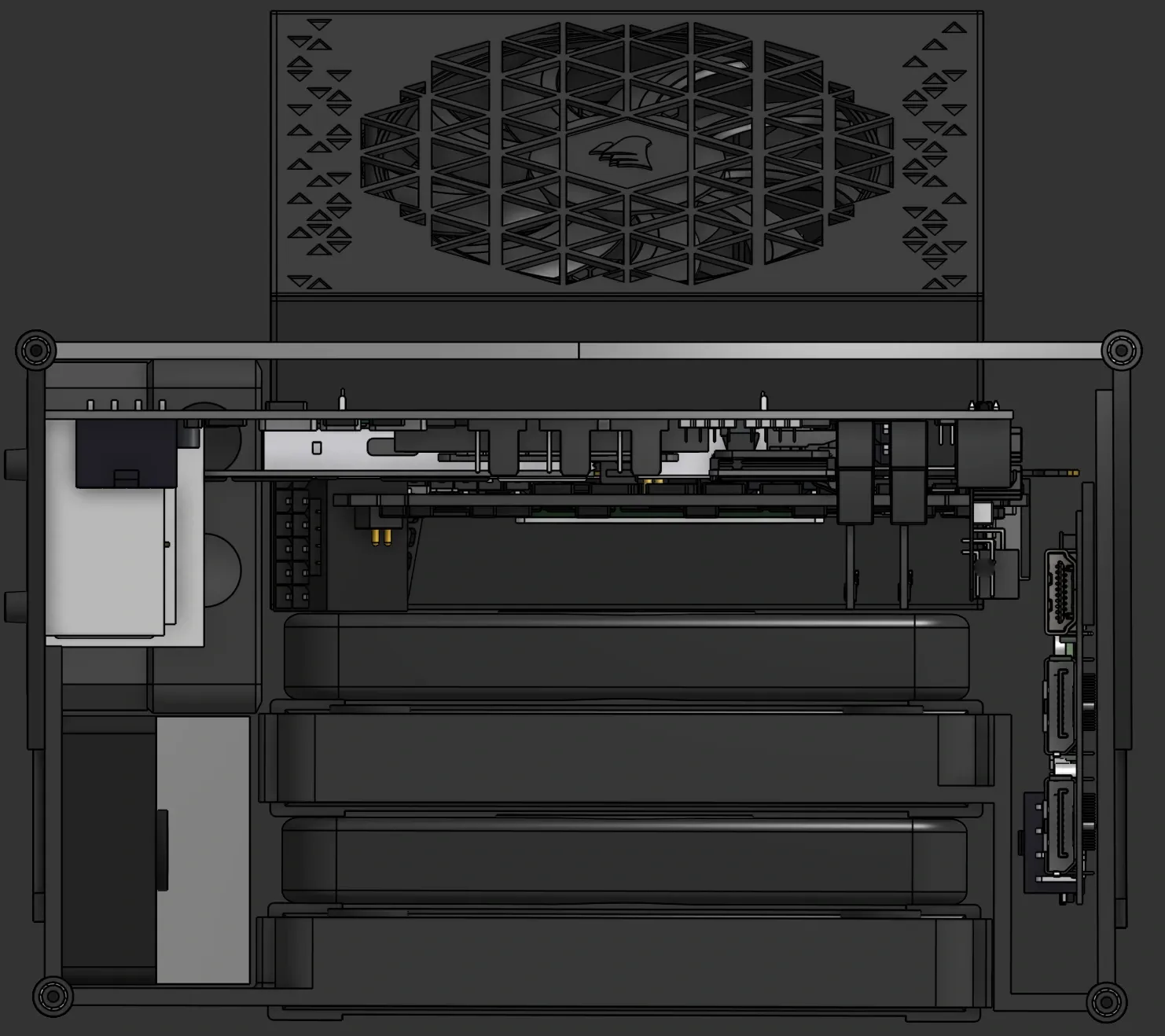
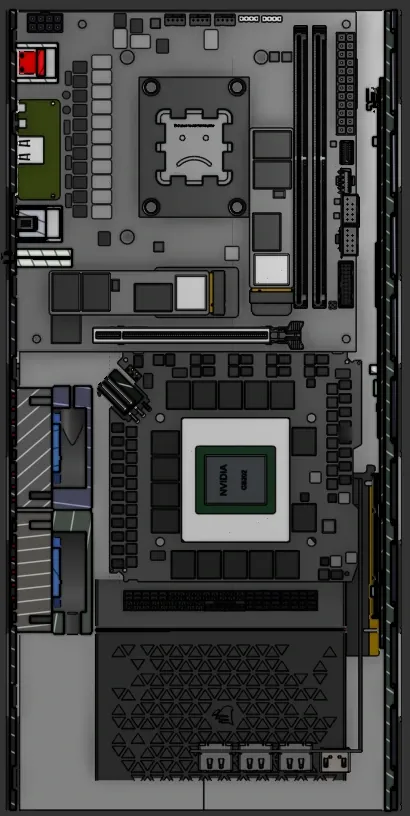
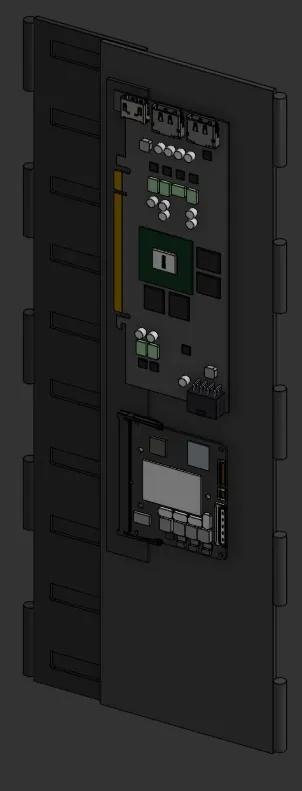
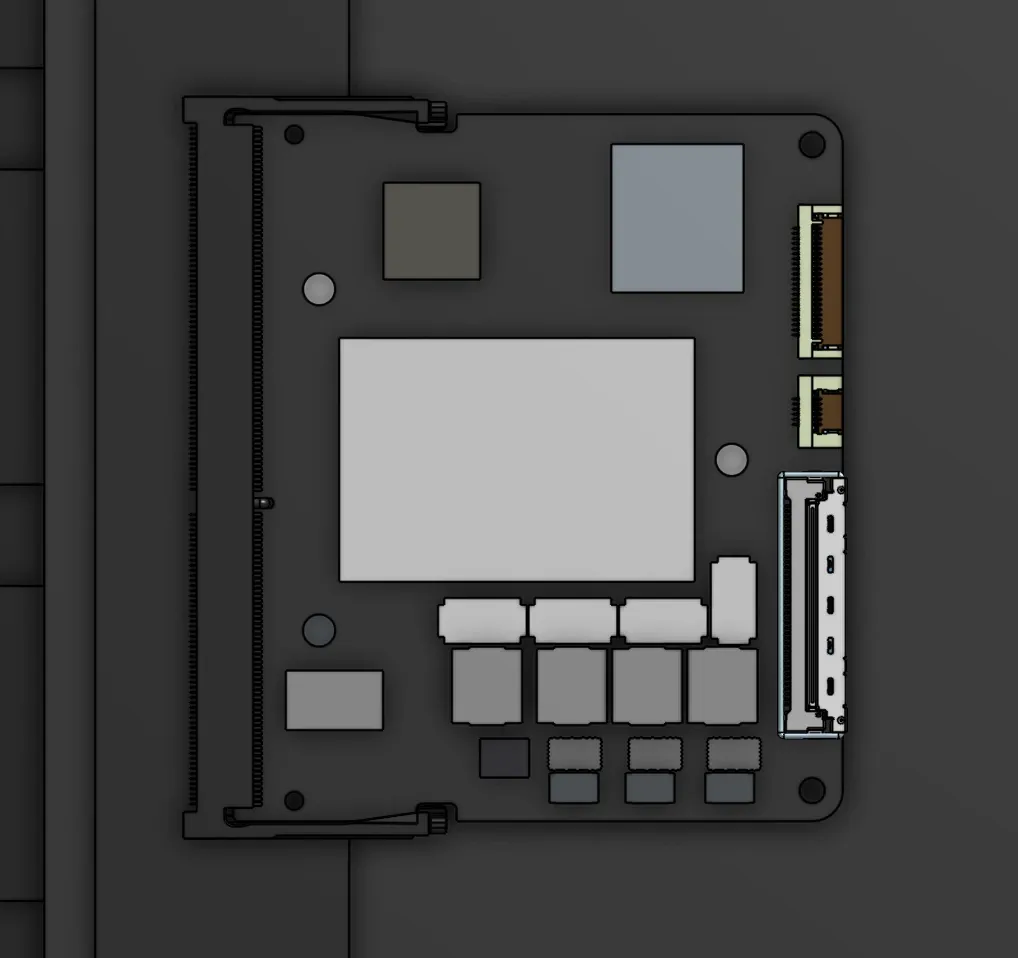
The main system sits on the center section. On the inner right, a LattePanda Mu Ultra (Intel Core Ultra 7 256V) with a low-profile RTX 5060 runs alongside it.

Main

Rendering, work and simulation

Motherboard
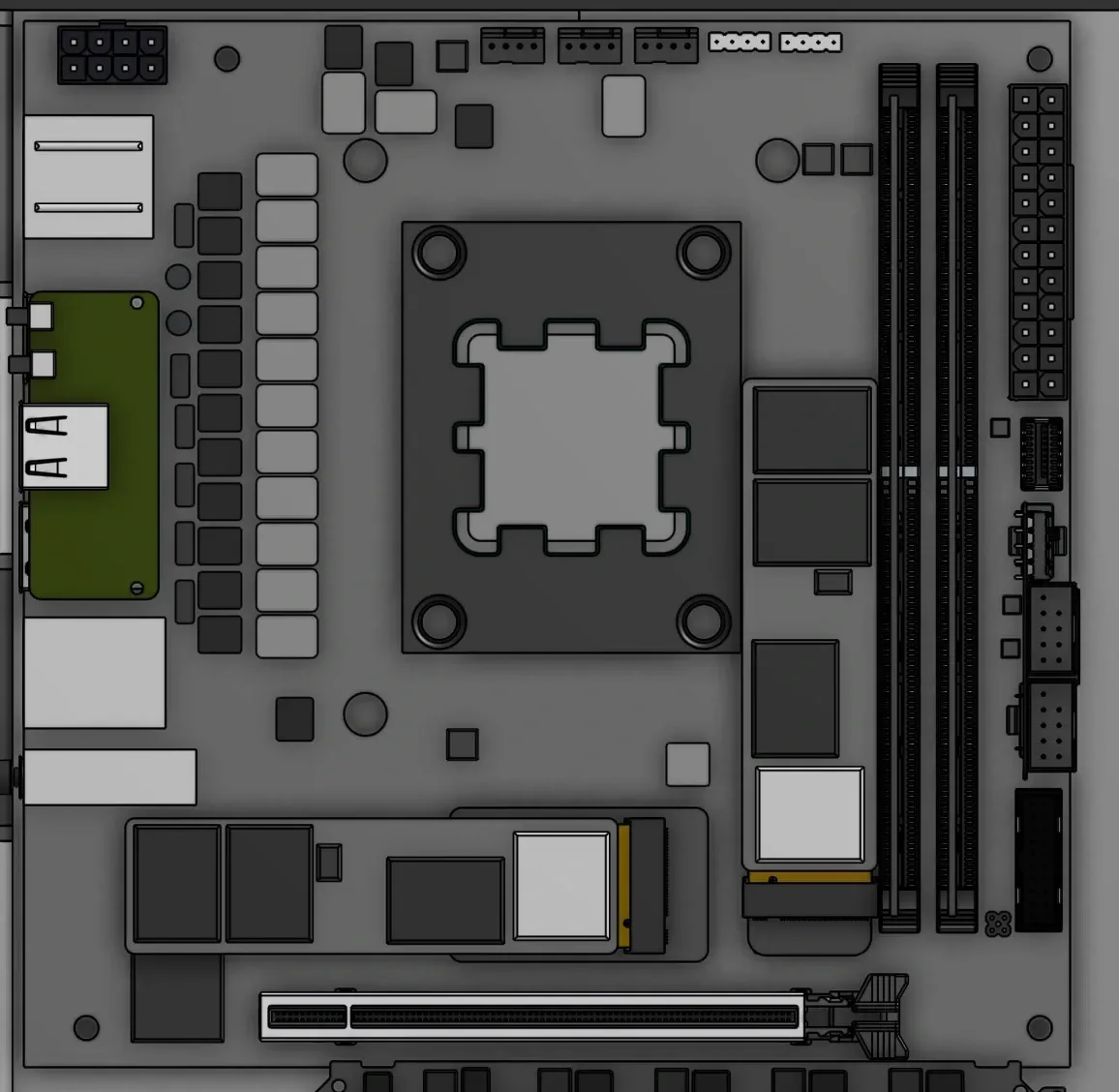
ASUS ROG Strix X870-I Gaming WiFi
CPU
AMD Ryzen 9 9950X3D
RAM
96 GB DDR5-6000 CL28
GPU
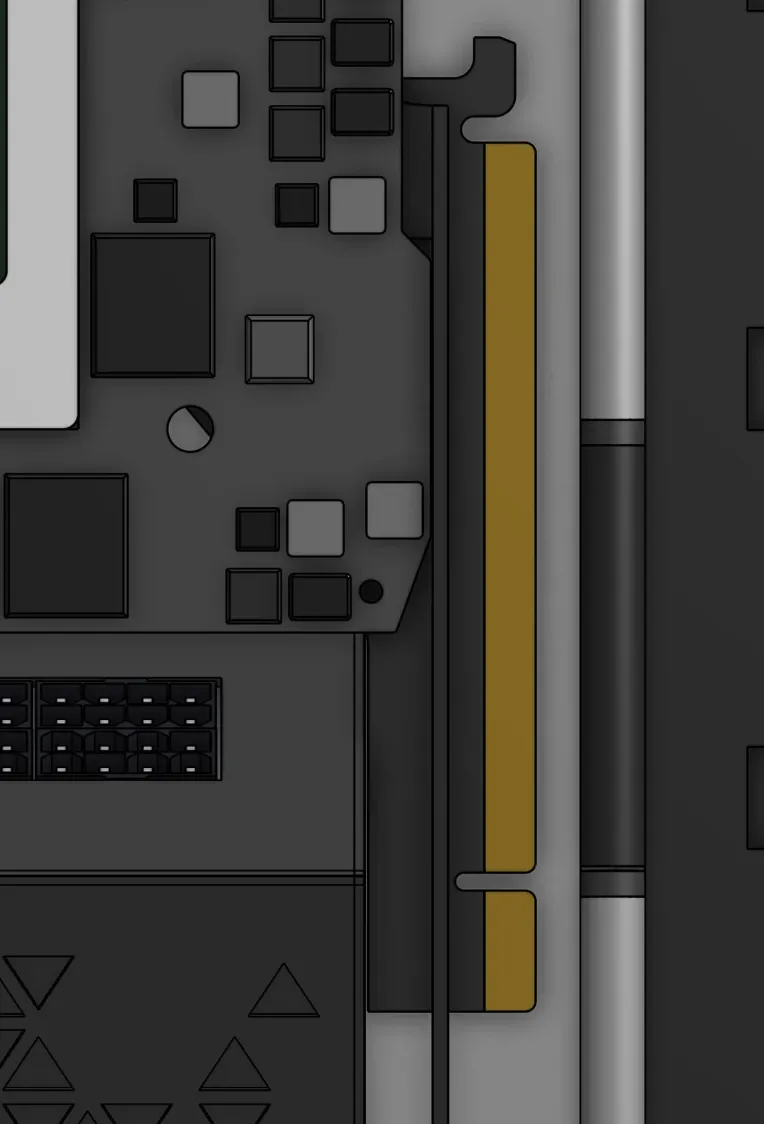
NVIDIA RTX 5090 Founders Edition, on a riser
Storage
4 TB Crucial T705, PCIe Gen5 NVMe

Secondary

System monitoring · Remote access · Offloading compute

Compute module
LattePanda Mu Ultra
CPU
Intel Core Ultra 7 256V
GPU
ZOTAC GAMING GeForce RTX 5060 Low Profile
GPU memory
8 GB GDDR7
GPU size
182.5 × 69 × 38.2 mm

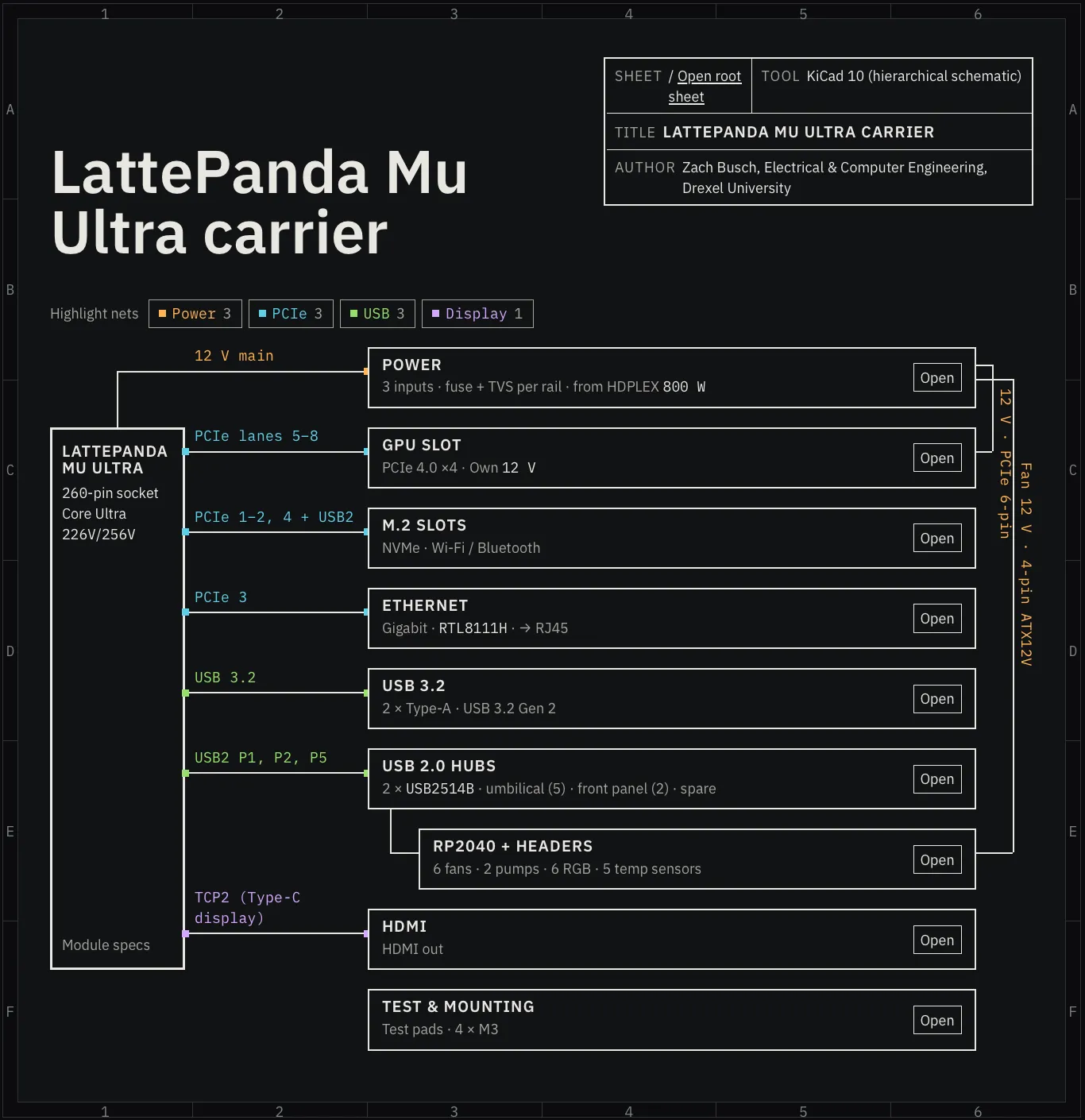
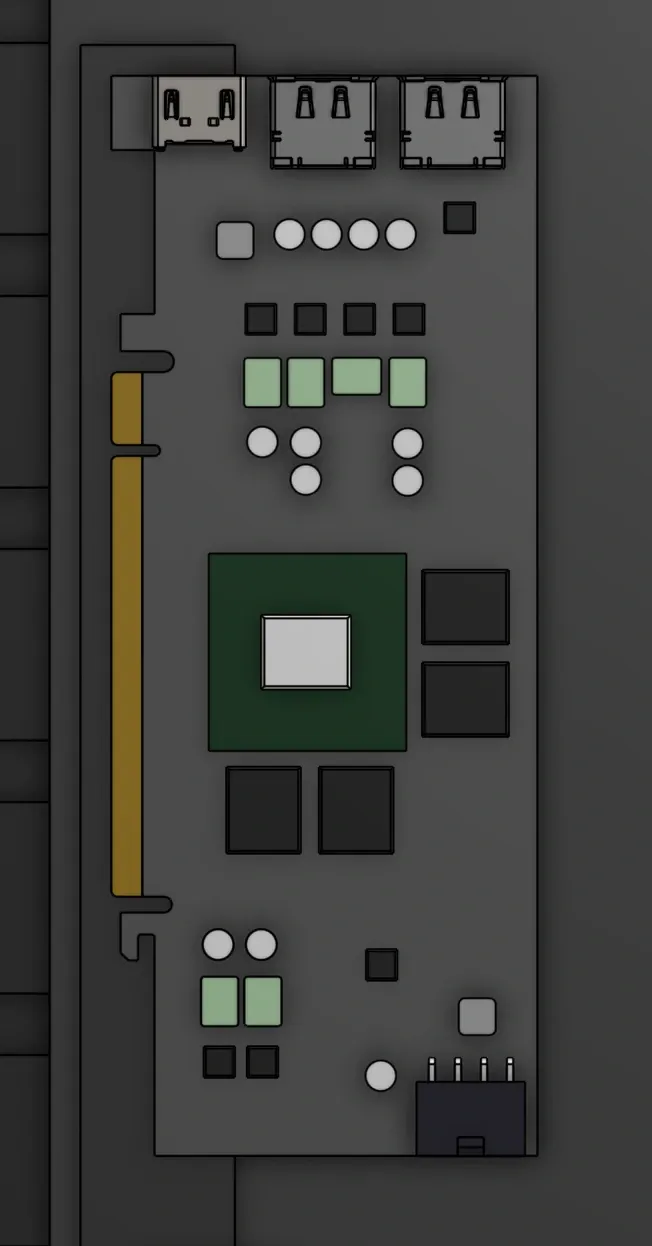
Custom carrier board

Module
LattePanda Mu Ultra, 260-pin socket
GPU slot
PCIe 4.0 ×4, own 12 V
Power
12 V from the second HDPLEX 800 W board
Storage
M.2 NVMe, M.2 Wi-Fi / Bluetooth
I/O
Gigabit Ethernet, 2 × USB 3.2 Gen 2, HDMI
Control
RP2040: 6 fans, 2 pumps, 6 RGB, 5 temperature sensors
Designed in
KiCad 10
Carrier board: full write-up →
Power
SupplyExternal fanless AC-DC
Bus48 V
Boards2 × HDPLEX 800 W DC-ATX
Each, continuous / peak720 W / 1,080 W
Each, size170 × 90 × 31 mm
Input range12-63 V
Board 1RTX 5090
Board 2Everything else
Board 2, load~425-475 W

08Process

Iterations

Five versions over two years, from a case where nothing moved to the hinge, slider, hinge linkage it has now.

  1. Version 1

    Everything fixed in place; nothing moves. A top fan and a bottom fan push air out of the case, and six side fans pull air in through the radiators.

  2. Version 2

    Added a single hinge, so the radiators fold out. Each radiator gets its own fresh air, and no heat is trapped in a box.

  3. Version 3

    Added a slider: a hinge and a slider on each side. The structure can shrink when folded, for a smaller closed volume.

  4. Version 4

    Rethought the part layout and refined the case design, keeping the hinge and slider.

  5. Version 5Current

    Added a second hinge: hinge, slider, hinge. Closed, the wings wrap the center and sit flush; open, they can take almost any position. The current design.

09Process

Tools

Case development began in Onshape. With the waterblocks, the work moved to SolidWorks, where simulation drives the design. Blender handles visualization and design studies of the case.

11Reference

Full specs

Case and structure

Case
FormFolding, three sections plus two wings
SectionsCenter, inner left, inner right, left wing, right wing
Size, closed195 × 400 × 115 mm
Volume, closed~9 L
AirflowIn through the front, out the back
Front I/OEvery internal header on the X870-I
Motherboard sizeMini-ITX
CADOnshape (case), SolidWorks (waterblocks, simulation)
VisualizationBlender
Structure
BackplateCarbon fiber
Backplate thickness3 mm
Component-side plyG10 fiberglass
InsertsBonded titanium or stainless steel
FinishMatte carbon, black-tinted satin clearcoat
Hinge arms, knuckles, slidersGrade 5 titanium, Ti-6Al-4V
Hinge arm thickness, target~2.2-2.5 mm
Moving contactsSteel bearings, pins or bushings
Wing framesTitanium
GroundingDedicated chassis ground strap
Wing mass~1.2 kg

Cooling loop

Radiators
ModelXSPC TX360 ultra-thin
Count2
Size125 × 20.5 × 398 mm
Core16 mm
Fin density22 FPI
MaterialCopper and brass
Fans
ModelArctic P12 Slim
Count6
Per radiator3
Thickness15 mm
Max speed2,100 rpm
Airflow, each71.5 m³/h
Pumps
ModelLaing DDC 4.2 PWM
Count2
Voltage12 V
Max power, each20 W
Speed1,000-4,500 rpm
Max flow, each517 L/h
Max head4.34 m
ArrangementIn series
Max pressure0.4 bar
Size91 × 70 × 40 mm
Weight, each220 g
Reservoir
Outside340 × 47 × 33 mm
Wall3 mm
Inside volume~370 mL
Loop
LayoutOne series loop
OrderReservoir → pumps → RTX 5090 → LattePanda Mu Ultra → RTX 5060 → right radiator → CPU → left radiator
Flow, operating~3.5-4 L/min
Restriction, whole loop~1.08 bar
Pumps, deadhead in series~1.15 bar
Flow sensorHard shutdown on low flow
TubingFlexible
Through-board tube, OD / ID4.5 / 3.5 mm
Through-board tubeCopper, PTFE sleeve

Cooling estimate

Stock heat load
RTX 5090~575 W
CPU~200 W
RTX 5060~145 W
LattePanda Mu Ultra~30 W
Pumps40 W
Total~1,000 W
Cooling estimate
Radiator capacity, both at full fan speed~30-35 W/°C
Short peaks, absorbed by the loop’s thermal mass1,300-1,400 W
Sustained capacity~1,100 W est.

Waterblocks

CPU monoblock
StatusIn progress
Designed inSolidWorks
BodyC145 tellurium copper, cast acrylic top
PlatingNi-P, ASTM B733 mid-phos, 10-12 µm
Thickness6.5 mm, ~7.5-8 mm at the port boss
ChannelsTwo 4.0 × 3.5 mm branches into a 6.0 × 3.5 mm trunk
BendsR4 centerline on the branches, R6 on the trunk (R2 / R3 inner)
Jet plateC360 brass, cut by wire EDM
JetOne 25 × 0.475 mm slot, 0.10 mm standoff
Jet stackThree pieces, swappable 0.58 mm spacer
Jet slotsCut oversized to allow for the plating
Seal2.0 mm O-ring in a 2.70 × 1.50 mm groove
FastenersM3 A2 stainless, nylon washers
Pressure drop, block~0.38 bar
Pressure drop, jet plate~0.3 bar
First estimate, block0.7 bar
RTX 5090 block
StatusIn progress
CardFounders Edition
DesignPedestal inside the card’s brace window
Pedestal bridge~1.0-1.2 mm, GDDR7 tops to die
Thermal interface
CPU and GPU diesThermal Grizzly KryoSheet
Everything elseLaird Tflex HD700 / HD7.5 pads

Computers and power

Main system
MotherboardASUS ROG Strix X870-I Gaming WiFi
CPUAMD Ryzen 9 9950X3D
RAM96 GB DDR5-6000 CL28
GPUNVIDIA RTX 5090 Founders Edition, on a riser
Storage4 TB Crucial T705, PCIe Gen5 NVMe
Secondary system
Compute moduleLattePanda Mu Ultra
CPUIntel Core Ultra 7 256V
GPUZOTAC GAMING GeForce RTX 5060 Low Profile
GPU memory8 GB GDDR7
GPU size182.5 × 69 × 38.2 mm
Power (planned)
SupplyExternal fanless AC-DC
Bus48 V
Boards2 × HDPLEX 800 W DC-ATX
Each, continuous / peak720 W / 1,080 W
Each, size170 × 90 × 31 mm
Input range12-63 V
Board 1RTX 5090
Board 2Everything else
Board 2, load~425-475 W
Motherboard I/O
USB4 40Gbps, Type-C2
USB 10Gbps5 (4 Type-A, 1 Type-C)
USB 2.03
VideoHDMI
NetworkIntel 2.5Gb Ethernet, Wi-Fi
ButtonsBIOS FlashBack, Clear CMOS
Internal USBUSB 10Gbps Type-C, USB 5Gbps header (2 ports), USB 2.0 headers (3 ports, on the ROG FPS card)
Internal other2 × ARGB Gen 2, power button, front panel, thermal sensor
Fan headersCPU fan, AIO pump, chassis fan
M.22 (PCIe 5.0 x4 and PCIe 4.0 x4)